
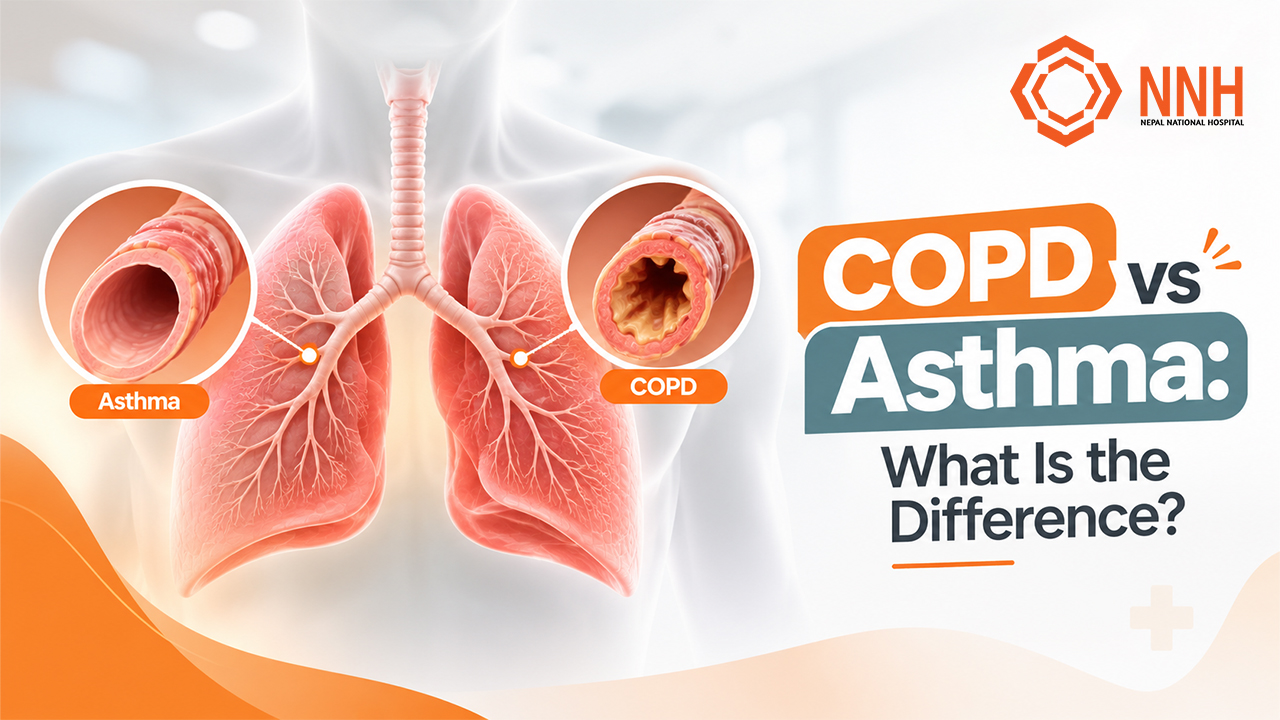
COPD and asthma can look surprisingly similar. Both can cause cough, wheezing, shortness of breath and chest tightness, and both can suddenly become worse during a flare-up.
They are not, however, the same lung condition.
Asthma typically causes respiratory symptoms that vary over time and may be triggered by exercise, respiratory infections, allergens, smoke, weather changes or other irritants. COPD more often causes persistent respiratory symptoms and persistent airflow limitation, commonly in people with a history of tobacco smoke, household smoke, occupational dusts or other harmful exposures.
These patterns are useful clues, but they are not enough to diagnose yourself.
Some people develop asthma as adults. Some people with COPD have never smoked. A person may also have features of both conditions.
The practical difference therefore comes down to the symptom pattern, medical and exposure history, lung-function testing and clinical assessment.
COPD vs Asthma at a Glance
| Feature | Asthma | COPD |
|---|---|---|
| Typical symptom pattern | Often varies considerably over hours, days or seasons | More often persistent and gradually limiting |
| Common symptoms | Wheeze, cough, chest tightness, breathlessness | Breathlessness, chronic cough, phlegm, wheeze, fatigue |
| Typical triggers/clues | Allergens, exercise, viral infections, smoke, cold air; allergy history may coexist | Tobacco smoke, household/biomass smoke, occupational dusts/fumes and air pollution |
| Age | Can begin at any age | Commonly becomes apparent from mid-life onward |
| Lung-function pattern | Variable airflow limitation may be demonstrated | Persistent airflow obstruction must be demonstrated for diagnosis |
| Core treatment emphasis | Controlling airway inflammation, generally with inhaled corticosteroid-containing treatment | Bronchodilation, exposure reduction and broader COPD management |
| Can symptoms suddenly worsen? | Yes | Yes |
| Can someone have both? | Yes | Yes |
This table describes common patterns, not diagnostic rules.
A 55-year-old smoker can have asthma. A nonsmoker can develop COPD. Someone with long-standing asthma can have persistent airflow limitation. That is why age, smoking history or wheezing alone cannot reliably settle the diagnosis.
Why Are Asthma and COPD Easy to Confuse?
Both conditions affect airflow through the lungs.
WHO lists cough, wheeze and breathing difficulty among symptoms that may occur with both COPD and asthma.
That overlap creates a common problem: people sometimes assume every recurring wheeze is asthma or every chronic cough in an older smoker is COPD.
Neither assumption is safe.
Breathlessness can also arise from pneumonia, heart disease, anaemia, other lung diseases, deconditioning and several other causes. A clinician therefore needs to determine whether symptoms actually represent chronic airway disease before deciding whether the pattern fits asthma, COPD or something else.
How Do Asthma Symptoms Usually Behave?
Asthma is a chronic lung disease involving inflammation and narrowing of the airways.
WHO describes common asthma symptoms as:
- coughing
- wheezing
- shortness of breath and
- chest tightness.
A particularly useful diagnostic clue is variability.
Someone with asthma may feel relatively well at one time and noticeably worse at another. Symptoms may become more prominent at night, during exercise, during a viral infection, after exposure to smoke or dust, or around a particular allergen.
For example, a person might experience repeated night-time coughing and wheezing during cold weather but have few symptoms during other periods.
This variability supports an asthma pattern, but it does not prove the diagnosis by itself.
How Do COPD Symptoms Usually Behave?
COPD stands for chronic obstructive pulmonary disease.
It is a long-term lung disease associated with restricted airflow. Chronic bronchitis and emphysema describe important components or patterns that may occur within COPD.
Common symptoms include:
- progressive or persistent breathlessness
- long-standing cough
- regular phlegm production
- wheezing and
- tiredness.
WHO notes that COPD symptoms commonly emerge from mid-life onwards and can increasingly interfere with normal daily activities as the disease progresses.
A person may first notice that walking uphill, climbing stairs or carrying shopping requires more effort than it used to.
COPD also has flare-ups, sometimes called exacerbations, during which cough, sputum or breathlessness becomes noticeably worse.
So the statement that “asthma comes and goes while COPD is always the same” is too simplistic. Both conditions can fluctuate.
What Causes Asthma Compared With COPD?
Neither disease has one universal cause.
Asthma risk factors and triggers
Asthma reflects an interaction between biological susceptibility and environmental exposures.
WHO identifies factors associated with asthma including family history, allergic conditions such as eczema or allergic rhinitis, early-life factors, tobacco exposure, air pollution, allergens and some occupational exposures.
Asthma symptoms can also be triggered by:
- respiratory infections
- exercise
- smoke
- pollen or other allergens
- weather changes
- fumes and strong scents.
A trigger makes existing airway sensitivity more noticeable; it does not necessarily explain why an individual developed asthma.
COPD risk factors
Smoking is an important COPD risk factor, but COPD is not exclusively a smoker’s disease.
WHO also identifies second-hand tobacco exposure, household air pollution from biomass or coal, occupational dusts and chemicals, impaired lung development and the genetic condition alpha-1 antitrypsin deficiency among relevant causes or risk factors.
This matters in Nepal, where respiratory history should not focus only on cigarettes.
A clinician may also ask about cooking or heating smoke, workplace dust, construction exposure, welding fumes, chemicals and outdoor pollution.
WHO’s current respiratory-care work in Nepal specifically recognizes the continuing importance of improving diagnosis and management of asthma and COPD.
Does Wheezing Mean You Have Asthma?
No.
Wheezing is a sound produced when air moves through narrowed airways. Asthma commonly causes it, but COPD and several other respiratory disorders may cause wheezing as well.
Likewise, producing phlegm does not automatically mean COPD.
Symptoms tell the doctor where to investigate. They do not always identify the disease by themselves.
How Do Doctors Tell COPD and Asthma Apart?
A respiratory assessment usually combines several types of information.
1. The symptom pattern
The clinician may ask:
When did the symptoms start?
Do they occur every day or come and go?
Are they worse at night?
Does exercise trigger them?
Is there persistent phlegm?
Do respiratory infections repeatedly cause severe worsening?
How much has walking or exercise capacity changed?
2. Exposure and medical history
For COPD, long-term exposure history is particularly important.
That includes smoking but should also include second-hand smoke, household cooking/heating smoke, occupational dust, fumes and chemical exposure.
For asthma, clinicians may ask about childhood symptoms, allergies, eczema, allergic rhinitis, family history and recognizable triggers.
None of these clues should be interpreted in isolation.
3. Spirometry and pulmonary function testing
Objective lung-function testing is central when asthma or COPD is suspected.
Spirometry measures how much air you can forcefully exhale and how quickly you can expel it.
Two important measurements are:
FEV1: the amount of air expelled during the first second of forced exhalation.
FVC: the total forced vital capacity expelled during the manoeuvre.
The relationship between these measurements helps identify airflow obstruction.
For COPD, GOLD states that diagnosis requires persistent airflow obstruction demonstrated on post-bronchodilator spirometry, conventionally an FEV1/FVC ratio below 0.7 in the appropriate clinical context.
Asthma diagnosis instead looks for a compatible symptom history together with evidence that expiratory airflow limitation varies over time.
That distinction is one reason a proper breathing test matters.
Nepal National Hospital has a dedicated guide explaining pulmonary function testing in Kathmandu. The hospital states that PFT is available among its diagnostic services, although patients should confirm exactly which components have been ordered.
Does bronchodilator reversibility automatically prove asthma?
No.
Improvement after a bronchodilator can support an asthma diagnosis, but real patients do not always fall into perfectly separate categories.
People with COPD can show some bronchodilator responsiveness, while people with long-standing asthma may develop persistent airflow limitation.
The entire clinical picture matters.
4. Chest X-ray and other tests
A chest X-ray can help investigate alternative or additional causes of respiratory symptoms, but it does not replace spirometry for distinguishing asthma from COPD.
Depending on the circumstances, a clinician may also consider oxygen measurement, laboratory testing, additional pulmonary-function tests or more advanced imaging.
Not every patient needs every test.
Can You Have Both Asthma and COPD?
Yes.
WHO notes that some people have both conditions, and current respiratory guidance recognizes patients who display features of asthma and COPD together.
This situation is especially relevant in older adults, smokers or former smokers who also have a convincing asthma history.
The important point is not finding the perfect label yourself.
It is recognizing that treatment decisions can change when asthma features are present.
If previous records show an asthma diagnosis, childhood wheezing, significant allergies or strong variability in symptoms, tell your respiratory doctor even if COPD is now being considered.
Is the Treatment for COPD and Asthma the Same?
No.
There is some overlap in inhaled medication, but the treatment strategy differs substantially.
Asthma treatment
Controlling airway inflammation is central to asthma management.
WHO states that inhaled corticosteroids reduce airway inflammation and help reduce asthma symptoms and serious attacks. Bronchodilator medicines may also be used, and combination inhalers are common.
The current international asthma strategy is maintained by GINA, whose 2026 strategy report reflects the latest evidence review.
Treatment should be individualized according to symptom control, exacerbation risk, age, inhaler technique and other clinical factors.
Do not copy another person’s inhaler regimen.
COPD treatment
For COPD, inhaled bronchodilators are central to symptom management.
WHO also identifies smoking cessation, reduction of harmful exposures, vaccination, physical activity/pulmonary rehabilitation where available and appropriate, and selected use of other treatments as important components of COPD care.
Inhaled corticosteroids are appropriate for some people with COPD but are not automatically needed by every COPD patient.
Nepal National Hospital’s detailed guide to COPD treatment and management in Kathmandu covers this pathway in more depth.
Inhaler technique matters in both conditions
Even the correct medicine may work poorly if the inhaler is used incorrectly.
Technique depends on the inhaler device.
Nepal National Hospital’s step-by-step asthma inhaler guide explains why patients should demonstrate their actual technique rather than simply say that they know how to use the device.
WHO’s respiratory-care programme in Nepal has also highlighted inhaler education as an important element of chronic respiratory care.
Can Asthma Turn Into COPD?
The relationship is more complicated than one disease simply “turning into” another.
Asthma and COPD are distinct clinical conditions, but long-standing asthma can be associated with persistent airflow limitation in some people. Asthma and COPD risk factors can also occur in the same person.
Someone with asthma who also has substantial tobacco, biomass or occupational exposure may therefore develop features characteristic of COPD later in life.
It is more accurate to ask whether someone has:
- asthma
- COPD
- another respiratory problem or
- features of more than one airway disease.
Spirometry and clinical history help answer that question.
Can a Nonsmoker Have COPD?
Yes.
Smoking is an important COPD risk factor, but it is not required for the disease to occur.
WHO identifies household air pollution, occupational exposures, second-hand smoke, early-life factors and alpha-1 antitrypsin deficiency among other COPD risks.
A lifelong nonsmoker with persistent breathlessness and chronic cough should therefore not dismiss the possibility of chronic lung disease.
Likewise, being a smoker does not automatically establish COPD.
Which Is More Serious: COPD or Asthma?
This is not a useful way to decide whether symptoms need medical attention.
Both diseases can become serious.
Asthma can cause severe, potentially life-threatening attacks even in someone who feels relatively well between episodes.
COPD can cause progressive limitations, recurrent exacerbations, respiratory failure and other health complications.
Severity depends on the individual disease pattern, lung function, exacerbation history, treatment response and other medical conditions.
The right question is:
How well controlled is the condition, and what is the person’s risk of future worsening?
When Is Breathlessness an Emergency?
Do not wait for a routine COPD-versus-asthma assessment when breathing difficulty is severe.
Seek emergency medical care when a person:
- is gasping or struggling to breathe
- cannot get normal sentences out because of breathlessness
- develops blue, grey or unusually pale lips or skin
- suddenly becomes confused
- has severe chest tightness or chest pain or
- is rapidly becoming worse.
These symptoms can represent a severe respiratory attack or another medical emergency.
Nepal National Hospital publishes 24/7 emergency and ambulance services in Kalanki, Kathmandu.
COPD vs Asthma: What Should You Do if You Are Not Sure?
Do not try to decide solely from one symptom.
Instead, consider the whole pattern:
Symptoms that vary markedly, occur at night or follow recognizable triggers may increase suspicion of asthma.
Persistent breathlessness, chronic cough or sputum combined with significant tobacco, biomass, occupational or pollution exposure may increase suspicion of COPD.
But those are diagnostic clues not rules.
A useful respiratory evaluation should answer:
- Does the symptom pattern suggest chronic airway disease?
- What exposures and medical history matter?
- Is spirometry or another pulmonary-function test needed?
- Does testing show variable or persistent airflow limitation?
- Could another disease explain the symptoms?
- What treatment is appropriate for the confirmed diagnosis?
Nepal National Hospital provides pulmonology through its Department of Medicine and currently lists Dr. Prakash Paudyal, MBBS, MD, Pulmonologist, NMC No. 7319.
People with ongoing wheezing, persistent cough, unexplained breathlessness or uncertainty about a previous asthma/COPD diagnosis can ask whether a pulmonology consultation and lung-function assessment are appropriate.
Contact Nepal National Hospital
This article provides general educational information. It cannot determine whether an individual has asthma, COPD or another condition and does not replace evaluation by a qualified healthcare professional.
FAQs
Does a normal spirometry test rule out asthma?
Not necessarily. Asthma varies over time, so lung function may be normal when symptoms are absent or well controlled. When clinical suspicion remains, the clinician may repeat objective testing or use another appropriate diagnostic approach.
Can COPD symptoms come and go?
Yes. Baseline symptoms are often more persistent than typical asthma symptoms, but COPD can also have exacerbations during which breathlessness, cough or sputum becomes significantly worse.
Is phlegm more common in COPD than asthma?
Chronic sputum production is a classic COPD feature, but it is not exclusive to COPD. Infection, bronchiectasis and other respiratory conditions can also produce phlegm.
Can a chest X-ray tell whether I have asthma or COPD?
A chest X-ray can identify or exclude some alternative problems but does not directly measure airflow obstruction. Spirometry/PFT provides the more relevant objective information when asthma or COPD is suspected. GOLD identifies spirometry as essential for confirming COPD.
Should I see a pulmonologist for repeated wheezing?
Repeated or unexplained wheezing, persistent breathlessness, recurrent respiratory flare-ups or uncertainty about an existing diagnosis can justify respiratory evaluation. A pulmonologist can integrate the history, examination and lung-function results rather than relying on symptoms alone.