
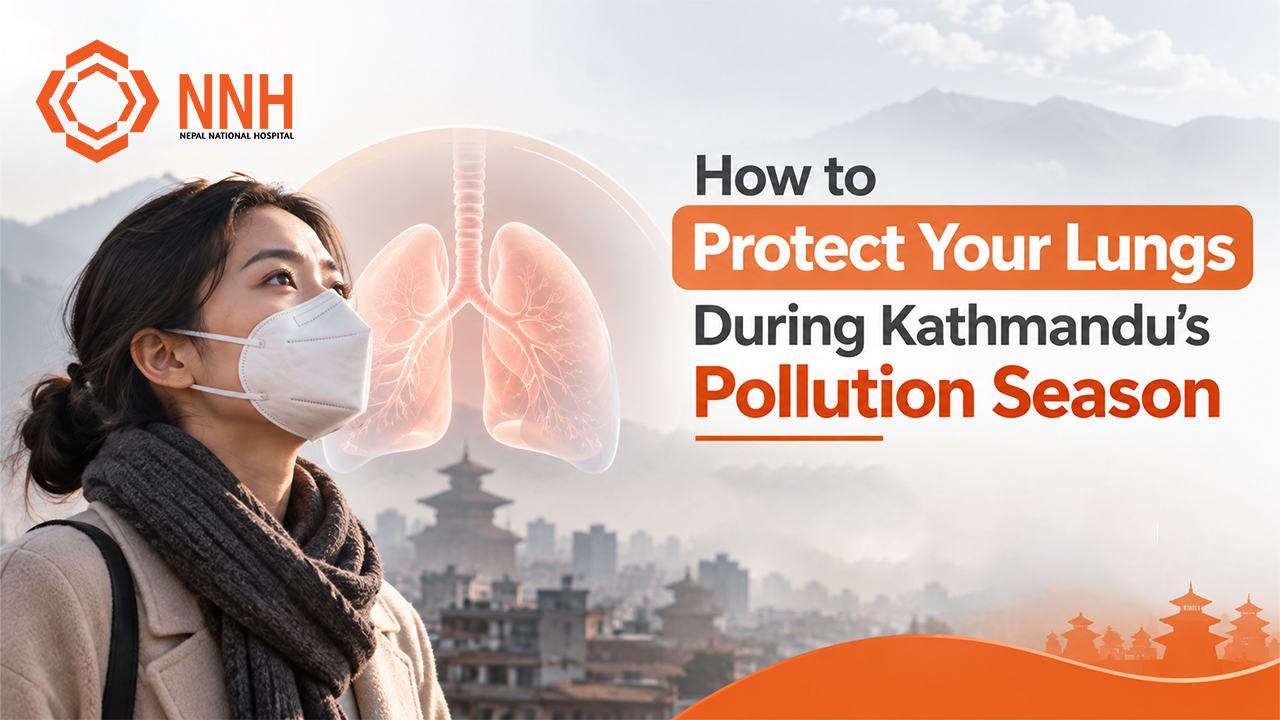
When Kathmandu’s air quality deteriorates, the most useful way to protect your lungs is to reduce the amount of polluted air you breathe. Check local air quality before planning prolonged outdoor activity, spend less time near heavy traffic and visible smoke, shift strenuous exercise when pollution is high, keep indoor pollution sources low, and take extra precautions if you have asthma, COPD or another heart or lung condition.
A well-fitting particulate respirator may reduce exposure to fine particles when outdoor exposure cannot be avoided, but no mask makes polluted air completely safe.
Kathmandu’s air pollution is not simply an inconvenience caused by dust. The World Health Organization identifies air pollution as a significant public-health problem in Kathmandu, while recent Nepal research continues to document high particulate exposure and associated respiratory risks.
This article explains what Kathmandu residents can realistically do to reduce lung exposure without fear, exaggerated claims or unnecessary medical testing.
Medical notice: This article provides general educational information. It cannot determine whether cough, wheezing, breathlessness or chest discomfort is caused by pollution, infection, asthma, COPD or another condition. Severe or rapidly worsening breathing difficulty requires urgent medical assessment.
Why Is Kathmandu Air Pollution a Lung-Health Concern?
Kathmandu Valley can experience substantial concentrations of fine particulate pollution, particularly during unfavourable weather and seasonal conditions.
Its location within a valley can limit dispersion of pollutants under certain atmospheric conditions, while emissions arise from multiple sources such as traffic, combustion, construction and regional pollution transport. WHO has identified Kathmandu’s air quality as an important environmental and public-health challenge. WHO’s Kathmandu Urban Health Initiative
Recent atmospheric research also continues to find elevated particulate concentrations in Kathmandu Valley, with seasonal variation and evidence that both local combustion and regional transport contribute to the problem.
The practical message is simple:
Your lungs respond to the pollution you actually inhale, not just whether the sky looks hazy.
Air can contain harmful fine particles even when visibility seems reasonable.
What Is PM2.5 and Why Does It Matter?
PM2.5 means particulate matter with a diameter of 2.5 micrometres or smaller.
These particles are small enough to penetrate deeply into the respiratory system. Air pollution exposure has been associated with respiratory disease, cardiovascular disease, lung cancer and other health problems.
Kathmandu pollution is not made up of PM2.5 alone. The air can also contain larger particles, nitrogen oxides, ozone, carbon monoxide and other pollutants.
However, PM2.5 deserves particular attention because fine particles can travel deep into the lungs and contribute substantially to the health burden associated with air pollution.
Is road dust the same as PM2.5?
Not exactly.
Visible road and construction dust often contains larger particles, while combustion from vehicles, burning and other sources can generate much finer particles.
A road may therefore look dusty and genuinely be unpleasant, but invisible fine-particle exposure can also be important.
That is why appearance alone is a poor way to decide whether air quality is safe.
Use AQI as a Daily Decision Tool
Instead of asking, “Is Kathmandu polluted today?” ask:
“What does today’s air quality mean for what I plan to do?”
Kathmandu Metropolitan City operates an official air-quality monitoring dashboard showing readings from multiple parts of the city. Kathmandu Metropolitan City air-quality monitoring dashboard
The dashboard uses categories such as:
| AQI | General category | Practical meaning |
|---|---|---|
| 0–50 | Good | Pollution risk generally low |
| 51–100 | Moderate | Usually acceptable, although particularly sensitive individuals may notice effects |
| 101–150 | Unhealthy for sensitive groups | Greater caution for children, older adults and people with chronic disease |
| 151–200 | Unhealthy | More people may experience health effects |
| 201–300 | Very unhealthy | Significant exposure concern |
| 301+ | Hazardous | Serious pollution episode |
The exact number matters less than understanding the trend and your personal vulnerability.
Someone with uncontrolled asthma may need to change plans at a pollution level that causes little noticeable discomfort in a healthy adult.
1. Check Air Quality Before Long Outdoor Exposure
Checking AQI takes less than a minute but can change several decisions:
- when you exercise
- whether children should spend prolonged periods outdoors
- whether an older adult should take a long roadside walk
- whether a person with asthma or COPD should reduce strenuous activity
- whether an outdoor worker needs additional exposure precautions.
Local readings are especially useful because pollution can vary across the valley.
Avoid treating a single AQI number as a diagnosis or guarantee. Monitoring stations give a useful estimate of environmental conditions, not the exact dose entering your lungs.
2. Reduce Time Near Heavy Traffic When Possible
Pollution exposure depends not only on how long you are outside but where you spend that time.
Busy intersections, idling traffic and major road corridors can produce much higher local exposure than quieter streets.
WHO guidance emphasises that changing the location and timing of activities can meaningfully alter exposure. WHO guidance on personal actions to reduce air-pollution exposure
Practical changes can include:
- taking a quieter parallel street for part of a walk
- avoiding unnecessary waiting beside idling buses or trucks
- moving exercise away from major roads
- keeping children away from heavily trafficked curbside areas when possible.
You do not need to eliminate every outdoor activity.
The goal is to reduce unnecessary high-concentration exposure.
3. Be Strategic About Outdoor Exercise
Exercise remains important for cardiovascular, respiratory and overall health.
The answer to pollution is therefore not automatically: “Stop exercising.”
WHO notes that regular physical activity retains substantial health benefits, although high pollution can increase inhaled pollutant dose because people breathe faster and more deeply during exercise.
A better approach during bad pollution episodes is to change:
- time
- location
- intensity
- or whether the activity happens indoors or outdoors.
For example, instead of a strenuous roadside run on a severely polluted day, a person might choose moderate indoor exercise or move activity to a cleaner location or time.
What about morning walks in Kathmandu?
Do not assume that early morning is always the healthiest time simply because traffic may look lighter.
Pollution concentrations vary with atmospheric conditions, weather and season.
Check current local air-quality information rather than following one permanent clock-time rule.
4. Understand What Masks Can and Cannot Do
Masks are one of the most misunderstood parts of pollution protection.
A particulate respirator is designed to filter airborne particles. Common standards include:
- N95
- KN95
- FFP2.
WHO explains that certified filtering respirators can remove a high proportion of particles when they are properly selected, properly worn and fit closely to the face.
However, several limitations matter.
Fit matters
A high-quality filter cannot work as intended if polluted air simply enters through gaps around the cheeks or nose.
A respirator should:
- cover the nose and mouth
- fit closely around the face
- be worn according to manufacturer instructions
- be replaced when damaged, heavily soiled or no longer functioning properly.
Certification matters
WHO advises caution with products that use labels such as “N95” or similar terminology without credible conformity testing.
Look for a respirator certified under a recognised standard rather than relying solely on marketing language.
A mask does not remove every pollutant
Particle-filtering respirators are primarily intended to reduce particulate exposure. They do not create clean outdoor air and should not be treated as complete protection from all gaseous pollutants.
Health-outcome evidence is less certain than filtration evidence
WHO notes that respirators can reduce inhaled particle exposure when properly used, but evidence that routine public use produces broad real-world health improvements is more limited.
This distinction matters.
A respirator can be a useful exposure-reduction tool, but it is not a substitute for reducing pollution at its source or avoiding unnecessary high-exposure situations.
People with significant heart or lung conditions who feel breathless or uncomfortable while using a respirator should discuss appropriate use with a healthcare professional rather than forcing themselves to wear one during strenuous activity.
5. Do Not Assume Staying Indoors Automatically Means Clean Air
Moving indoors can reduce outdoor pollution exposure—but only if indoor air is genuinely cleaner.
WHO specifically warns that indoor spaces can contain their own pollution sources, including:
- cigarette smoke
- second-hand smoke
- cooking emissions
- incense
- combustion
- outdoor pollution leaking indoors.
A room with closed windows but continuous indoor smoke may not be a healthy refuge.
Reduce avoidable indoor pollution
Useful steps include:
- keeping indoor spaces smoke-free
- avoiding unnecessary burning indoors
- improving kitchen exhaust and ventilation where appropriate
- limiting incense or other combustion during severe pollution episodes
- maintaining cooking appliances correctly.
Household air pollution remains an important respiratory-health issue in Nepal as well as outdoor pollution.
6. Can an Air Purifier Help?
A correctly sized portable air cleaner using appropriate particulate filtration can reduce indoor particle concentrations.
WHO’s review found that portable filters can substantially reduce indoor PM2.5 under studied conditions, although evidence about long-term clinical outcomes is less extensive.
If using a portable cleaner:
- match the unit to room size
- position it where people actually spend time
- keep filters maintained
- replace filters according to manufacturer instructions
- understand that filtration is not a replacement for controlling indoor smoke sources.
Avoid assuming the most expensive purifier is automatically the most effective.
The useful question is:
How much clean-air delivery does this device provide for this particular room?
Avoid ozone-generating devices
Some electronic air-cleaning technologies may generate ozone.
Ozone itself can irritate the respiratory system, so “air purification” should not introduce another harmful pollutant.
7. Protect Children, Older Adults and People With Chronic Disease More Carefully
Not everyone has the same susceptibility to pollution.
WHO identifies several groups that may be more vulnerable or susceptible, including:
- children
- older adults
- pregnant people
- people with respiratory disease
- people with cardiovascular disease
- outdoor workers.
These groups may benefit from reducing short-term exposure more aggressively during highly polluted episodes.
Children
Children breathe more air relative to their body size and often spend substantial time being physically active.
Parents can reduce exposure by checking local air quality before prolonged outdoor play and avoiding highly polluted roadside locations.
A child who repeatedly develops wheezing, nighttime cough or difficulty breathing should not simply be labelled “sensitive to pollution” without appropriate medical assessment.
Older adults
Older adults may have heart or lung disease even if they do not describe themselves as respiratory patients.
Watch for:
- new breathlessness
- reduced walking tolerance
- persistent cough
- unusual tiredness
- dizziness
- chest discomfort.
These symptoms deserve medical assessment rather than being automatically attributed to Kathmandu’s air.
8. What Should People With Asthma Do During Pollution Episodes?
Air pollution can aggravate asthma symptoms in susceptible people.
The most important step is not to invent a new treatment each time pollution rises. Continue your clinician-prescribed asthma plan and make sure inhaler technique is correct.
Nepal National Hospital has separate guidance on correct asthma inhaler technique as well as asthma-focused respiratory content.
During poor air quality:
- reduce unnecessary heavy outdoor exertion if pollution triggers symptoms
- carry prescribed reliever medication according to your asthma plan
- avoid smoke and tobacco exposure
- pay attention to increasing reliever use
- seek medical review if asthma control deteriorates.
Repeated wheezing during polluted periods can be a sign that baseline asthma management needs reassessment.
9. What Should People With COPD Do?
People living with COPD can be particularly sensitive to poor air quality.
Pollution can worsen:
- cough
- sputum
- wheezing
- chest tightness
- exercise tolerance
- breathlessness.
Do not change maintenance inhalers or oxygen treatment without clinical guidance.
If symptoms are becoming more frequent or limiting daily activities, the underlying COPD plan may require review.
Nepal National Hospital provides additional information about COPD treatment and respiratory management in Kathmandu.
Severe or rapidly worsening breathlessness should be treated as a medical problem not merely as an unavoidable consequence of pollution.
10. Do Supplements, Steam or “Detox” Drinks Clean Pollution From the Lungs?
There is no established drink, vitamin, herbal preparation or steam treatment that mechanically “washes PM2.5 out of the lungs.”
Healthy nutrition and adequate hydration are valuable for general health, but they should not be marketed as pollution detoxification.
Similarly, steam inhalation may temporarily feel soothing to some people but does not remove inhaled particulate pollution from lung tissue.
The most evidence-based strategy is still:
reduce exposure before excessive pollution reaches the lungs.
Be cautious with products claiming to “detox lungs,” “reverse pollution damage” or “clean PM2.5 from the body” without high-quality clinical evidence.
What Symptoms Can Pollution Cause?
Air pollution can irritate the respiratory tract and contribute to symptoms such as:
- cough
- throat irritation
- nasal irritation
- wheezing
- chest tightness
- shortness of breath
- eye irritation.
But these symptoms are not specific to pollution.
A cough can also come from:
- viral infection
- pneumonia
- asthma
- COPD
- tuberculosis
- reflux
- allergy
- medication
- another respiratory condition.
That is why persistent symptoms should not be self-diagnosed solely from an AQI reading.
Nepal National Hospital also provides a dedicated guide to pneumonia symptoms and treatment in Kathmandu.
How Do You Know Whether Pollution Is Affecting Your Lungs?
There is no single routine test that tells a person, “pollution has damaged your lungs.”
A clinician starts with the pattern of symptoms, exposures and physical examination.
Depending on the problem, evaluation might include:
- oxygen saturation
- chest examination
- spirometry or pulmonary function testing
- chest imaging
- laboratory tests
- assessment for asthma, COPD or infection.
The correct tests depend on the clinical question.
Does everyone exposed to Kathmandu pollution need a PFT?
No.
A pulmonary function test is not a screening test that every Kathmandu resident needs simply because air quality is poor.
It becomes more relevant when a person has symptoms such as:
- recurring wheeze
- persistent unexplained breathlessness
- chronic cough
- suspected asthma
- suspected COPD
- reduced exercise tolerance
- another indication identified by a clinician.
Nepal National Hospital explains the purpose and limitations of pulmonary function testing in Kathmandu.
When Should You See a Doctor for Pollution-Related Breathing Symptoms?
Seek medical assessment when respiratory symptoms are persistent, recurrent, worsening or interfering with normal activity.
Consider evaluation if you develop:
- cough that does not settle
- repeated wheezing
- breathlessness with routine activity
- nighttime respiratory symptoms
- persistent chest tightness
- significant reduction in exercise tolerance
- repeated respiratory flare-ups
- symptoms despite appropriate asthma or COPD medication.
A pulmonologist can help determine whether pollution is acting as a trigger for an underlying respiratory condition rather than assuming pollution is the only cause.
Nepal National Hospital provides pulmonology and respiratory care through its Department of Medicine in Kalanki, Kathmandu.
When Is Breathing Difficulty an Emergency?
Do not wait for a routine appointment when breathing becomes severely difficult.
Urgent assessment is appropriate for symptoms such as:
- severe breathlessness at rest
- inability to speak normally because of breathlessness
- blue or unusually pale lips
- confusion or unusual drowsiness
- severe chest pain
- collapse or fainting
- rapidly worsening asthma
- severe breathing symptoms that do not respond as expected to a prescribed emergency plan.
Nepal National Hospital’s official service information lists 24/7 emergency services and critical-care facilities.
A Practical Kathmandu Pollution-Day Checklist
When air quality deteriorates, use this simple sequence.
Before leaving home
- Check a nearby air-quality monitoring location.
- Consider your own risk especially asthma, COPD, heart disease, pregnancy, older age or young children.
- Ask whether the outdoor activity is necessary.
- Change the route, time or intensity if that meaningfully reduces exposure.
- If particulate exposure is unavoidable, consider an appropriately certified, well-fitting respirator.
During your commute
Keep unnecessary time beside idling traffic as short as practical.
Avoid smoke sources when an alternative route exists.
Do not assume a motorcycle helmet or loose cloth covering provides reliable fine-particle filtration.
At home
Keep indoor smoking and unnecessary combustion out of the living space.
Use appropriate kitchen exhaust.
On severe pollution days, manage doors and windows according to outdoor conditions while also avoiding the buildup of indoor pollutants.
Where practical and affordable, an appropriately sized particulate air cleaner can reduce indoor particle levels.
If you exercise
Do not abandon regular physical activity permanently because of pollution.
Instead adjust timing, location or intensity during significant pollution episodes.
People with heart or lung disease should be more conservative when pollution is high.
If you develop symptoms
Do not keep increasing self-treatment indefinitely.
A repeated pattern of cough, wheeze or breathlessness may signal asthma, COPD or another respiratory problem that deserves evaluation.
Seven Common Pollution-Protection Mistakes
1. Waiting until the sky looks brown
Visible haze is not a reliable measurement of fine-particle concentration.
Use monitoring data.
2. Believing any mask works equally well
Material, certification and especially fit matter.
3. Exercising beside heavy traffic because “exercise is healthy”
Exercise is healthy, but location affects exposure.
Move away from pollution sources when practical.
4. Closing every window while producing smoke indoors
Indoor air may become polluted too.
Control indoor sources.
5. Buying a purifier without considering room size
A filter that cannot circulate enough air for the room may provide limited benefit.
6. Treating every cough as pollution
Respiratory infections, asthma, COPD and other diseases can produce similar symptoms.
7. Stopping prescribed respiratory medicines whenever symptoms improve
Asthma and COPD treatment should follow the plan provided by your clinician rather than AQI fluctuations alone.
Key Takeaways
Kathmandu air pollution is a legitimate respiratory-health concern, but protecting your lungs does not require panic.
The most useful strategy is exposure reduction.
Check local air quality, reduce unnecessary time near major pollution sources, adapt outdoor exercise during severe episodes, keep indoor air as clean as practical, and understand the limits of masks and air purifiers.
People with asthma, COPD, cardiovascular disease and other chronic conditions should be especially attentive during high-pollution episodes.
Most importantly, do not automatically blame persistent cough or breathlessness on air pollution.
If respiratory symptoms repeatedly interfere with sleep, exercise, work or normal daily activity, clinical assessment can help identify whether an underlying lung condition is contributing.
Respiratory Assessment in Kathmandu
Nepal National Hospital provides pulmonology through its Department of Medicine in Kalanki, Kathmandu. The department lists Dr. Prakash Paudyal, MBBS, MD, Pulmonologist, NMC No. 7319.
Readers who want broader information about respiratory evaluation can also review Nepal National Hospital’s pulmonology and lung-care guide.
For persistent cough, recurring wheezing or unexplained breathlessness, consider a respiratory consultation.
For severe or rapidly worsening breathing difficulty, seek emergency medical care rather than waiting for a routine appointment.
FAQs
Is Kathmandu pollution bad for the lungs?
Yes. Air pollution, especially exposure to fine particulate matter, is associated with respiratory disease and can worsen existing heart and lung conditions. Kathmandu has a documented air-pollution problem, although an individual’s health risk depends on pollution intensity, duration of exposure and personal susceptibility.
What mask is best for Kathmandu air pollution?
When particulate exposure cannot be avoided, a properly certified and well-fitting particulate respirator such as an N95, KN95 or FFP2 can reduce particle exposure. Fit and genuine certification matter. A respirator does not eliminate all pollution exposure and does not filter every gaseous pollutant.
Does a surgical mask protect against PM2.5?
Loose-fitting surgical masks are primarily designed for different purposes and generally do not provide the same fit-based particulate protection as a properly fitted particulate respirator. For pollution, fit and tested filtration are important.
Should I stop running when Kathmandu is polluted?
Not necessarily. Physical activity remains beneficial. On substantially polluted days, reduce exposure by changing the timing, route, location or intensity of exercise. People with asthma, COPD or cardiovascular disease may need to be more cautious.
Do air purifiers protect against Kathmandu pollution?
A suitably sized particulate air cleaner can lower indoor particle levels. Effectiveness depends on the purifier, room size, outdoor-air infiltration and indoor pollution sources. Purifiers reduce exposure; they do not make every indoor environment pollution-free.
Can air pollution cause asthma?
Air pollution is associated with asthma development and exacerbation, but asthma is influenced by multiple genetic and environmental factors. New or recurrent wheezing should be clinically assessed rather than diagnosed from pollution exposure alone.
Can pollution cause a permanent cough?
Pollution can irritate the respiratory system and contribute to cough, but a persistent cough has many possible causes. Asthma, COPD, infection, tuberculosis, reflux and other disorders should be considered when symptoms continue.
Should healthy people get lung tests because they live in Kathmandu?
Routine PFT for every asymptomatic resident is not established practice. Lung-function testing becomes more useful when there are symptoms, suspected asthma/COPD, occupational risk or another clinical indication.
