
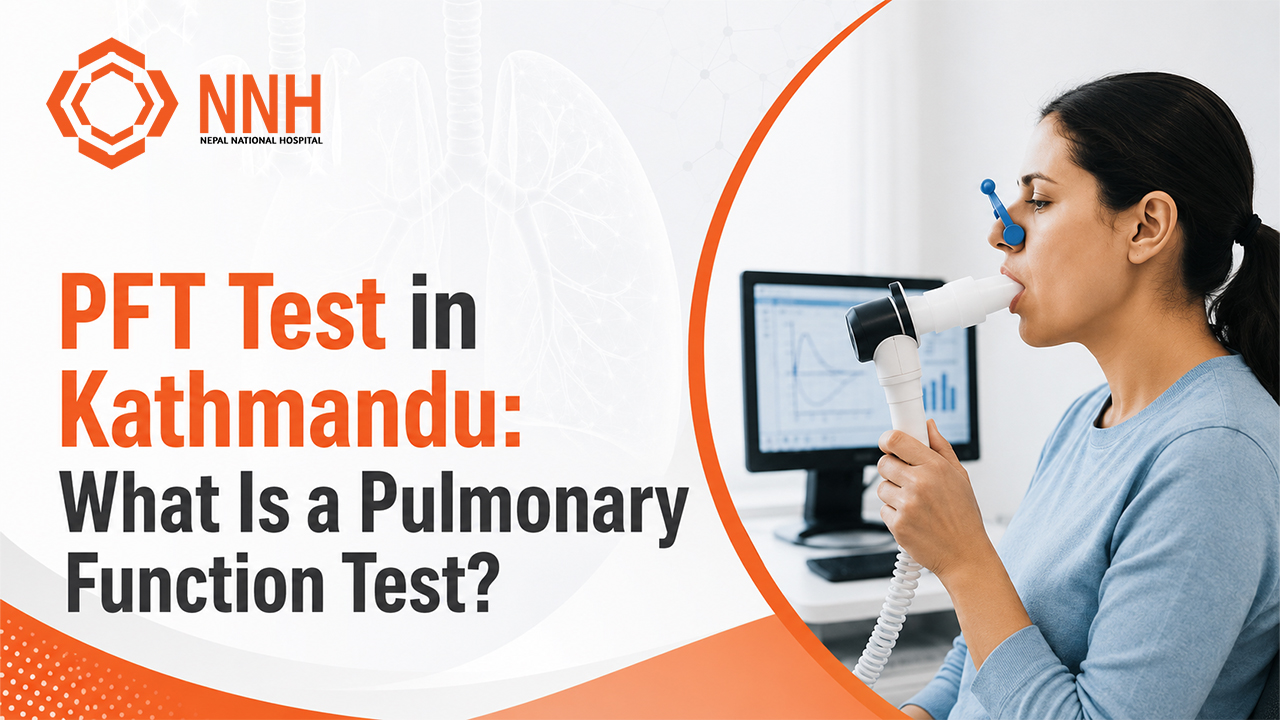
A pulmonary function test, or PFT, is a breathing assessment used to measure how well the lungs and airways are working. Depending on the test ordered, it can measure how much air a person can move, how quickly they can exhale, how much air the lungs can hold and how effectively gases pass from the lungs into the blood.
People researching a PFT test in Kathmandu may have persistent cough, wheezing, chest tightness, breathlessness, suspected asthma or COPD, an abnormal chest X-ray, or a need to monitor an existing lung condition. The test is usually non-invasive, but accurate results require clear instructions and good effort.
This guide explains the difference between PFT and spirometry, how the test is performed, how to prepare, what the measurements mean and when a pulmonology consultation may be appropriate.
Medical notice: This article provides general educational information. It cannot diagnose an individual respiratory condition or replace evaluation by a qualified healthcare professional.
What Is a Pulmonary Function Test?
A pulmonary function test is one of a group of tests used to evaluate airflow, lung capacity and other aspects of respiratory function.
PFTs are also called lung-function tests or respiratory-function tests. Most involve breathing through a mouthpiece attached to specialised equipment. Different tests answer different clinical questions, so “PFT” does not always refer to one identical procedure.
Pulmonary function testing may help a clinician understand:
- How much air a person can breathe in or out.
- How quickly air can be expelled.
- Whether the airways appear narrowed.
- Whether the lungs hold less or more air than expected.
- Whether air remains trapped after exhalation.
- How effectively gas moves from the lungs into the bloodstream.
- Whether lung function changes after an inhaled bronchodilator.
- Whether respiratory function is stable, improving or declining over time.
MedlinePlus defines PFTs as a group of tests that check how well the lungs are working. The measurements may include airflow, lung capacity and the transfer of oxygen from inhaled air into the blood.
A PFT result is not interpreted in isolation. The pulmonologist considers the patient’s symptoms, medical history, smoking and exposure history, examination, imaging and other investigations.
Is PFT the Same as Spirometry?
No. Spirometry is one type of pulmonary function test, while “PFT” is a broader term that can include several different breathing assessments.
In everyday conversation, people often say “PFT” when they mean basic spirometry. That usage is common, but it can cause confusion when booking a test.
Spirometry measures airflow
Spirometry mainly measures:
- How much air a person can forcefully exhale.
- How quickly that air comes out.
- Whether the airflow pattern suggests airway obstruction.
- Whether selected values change after a bronchodilator.
During spirometry, a person takes a deep breath and blows into a mouthpiece as hard, fast and completely as possible. The test is generally repeated several times to obtain technically acceptable and repeatable results.
A complete PFT may include additional measurements
Depending on the facility, equipment and clinical question, broader pulmonary-function testing may also include:
- Lung-volume testing.
- Body plethysmography.
- Gas-diffusion testing.
- Respiratory-muscle strength testing.
- Exercise testing.
- Bronchial-provocation testing.
- Impulse oscillometry.
- Exhaled nitric-oxide testing.
Not every hospital or pulmonary laboratory provides every test.
Nepal National Hospital’s website confirms that PFT is among its diagnostic services, but it does not publicly define whether this refers to spirometry alone or a wider test panel. Patients should confirm the exact test ordered before attending.
What Does a Pulmonary Function Test Measure?
The measurements depend on the specific test performed. Basic spirometry focuses on airflow, while more comprehensive testing may assess lung volumes and gas transfer.
What Is FVC?
Forced vital capacity, or FVC, is the total amount of air a person can forcefully exhale after taking the deepest possible breath.
A reduced FVC may occur for several reasons. The lungs may hold less air than expected, the person may not have inhaled fully, the exhalation may have ended too early, or severe airflow obstruction may prevent complete emptying.
A low FVC on spirometry does not by itself confirm a restrictive lung disorder. A restriction is generally confirmed by measuring total lung capacity.
What Is FEV1?
Forced expiratory volume in one second, or FEV1, is the amount of air exhaled during the first second of a forced breath.
FEV1 is influenced by airway size, airway narrowing, lung elastic recoil and the quality of the patient’s effort. It is commonly used to assess airflow limitation and to monitor selected respiratory diseases.
A low FEV1 can occur with airway obstruction, reduced lung volume, weak respiratory muscles, suboptimal effort or a combination of factors. It must therefore be interpreted with other values.
What Is the FEV1/FVC Ratio?
The FEV1/FVC ratio compares the amount exhaled in the first second with the total forced exhaled volume.
A ratio below the appropriate lower limit of normal can support the presence of airflow obstruction. Airflow obstruction may occur with conditions such as asthma or COPD, but the numerical pattern must be interpreted alongside symptoms and clinical evidence.
Current ERS/ATS interpretive guidance recommends comparing results with appropriate reference values and statistical limits rather than treating one universal percentage as normal for every person.
What Is Peak Expiratory Flow?
Peak expiratory flow is the highest airflow reached during a forceful exhalation.
It can be affected by effort and technique. Although peak-flow meters may be useful for monitoring some people with asthma, peak flow does not provide the same information as a full spirometry test.
What Are Lung Volumes?
Lung-volume testing measures how much air the lungs can hold and how much remains after exhalation.
Important measurements may include:
- Total lung capacity: The total amount of air in the lungs after the deepest possible inhalation.
- Residual volume: The air remaining after the person exhales as much as possible.
- Functional residual capacity: The amount of air remaining after a normal, relaxed exhalation.
- Vital capacity: The change in lung volume between full inhalation and full exhalation.
Body plethysmography is one method of measuring lung volumes. It generally involves sitting in a transparent enclosed cabin and breathing through a mouthpiece. Other gas-dilution or washout methods may also be used.
Lung-volume testing can help distinguish a genuinely reduced total lung capacity from a low FVC caused by another factor.
What Is Diffusion Capacity?
Diffusion-capacity testing assesses how effectively gas passes from the air sacs of the lungs into the pulmonary blood vessels.
The commonly reported value is called DLCO, or diffusing capacity of the lung for carbon monoxide. The test uses a medically controlled, very low concentration of carbon monoxide because it allows the equipment to measure gas transfer. The American Thoracic Society states that the low level used in this test is considered safe.
Diffusion capacity may be reduced in several conditions, including some forms of emphysema, interstitial lung disease, pulmonary vascular disease and anaemia. It can also be affected by smoking, haemoglobin level, altitude-related factors, technical quality and other clinical circumstances.
What Is a Bronchodilator Response Test?
In bronchodilator testing, spirometry is performed before and after the person inhales medicine designed to open the airways.
The clinician compares the results to assess whether airflow measurements have changed. This information may support the evaluation of asthma or other airway disorders, but one test does not always prove or exclude a diagnosis.
The term “bronchodilator response” is preferable to assuming that the test demonstrates permanent or complete “reversibility.” Results must be interpreted in the context of symptoms, treatment and other evidence.
Why Do Doctors Recommend PFT Testing?
Doctors recommend PFT when objective information about respiratory function may help answer a clinical question.
Common reasons include:
Investigating respiratory symptoms
PFT may be considered when someone has:
- Persistent or recurrent cough.
- Wheezing.
- Chest tightness.
- Shortness of breath.
- Reduced exercise tolerance.
- Difficulty taking a deep breath.
- Unexplained breathing symptoms.
- Repeated respiratory flare-ups.
These symptoms do not automatically mean a person has asthma or COPD. They may also occur with infection, anaemia, heart disease, reflux, deconditioning, anxiety-related breathing disturbance, occupational exposure or other conditions.
A PFT is one part of the evaluation.
Assessing suspected asthma
Asthma symptoms commonly vary over time. A person may have wheezing, cough, chest tightness or breathlessness that becomes worse after smoke, dust, infection, exercise, cold air or allergen exposure.
Spirometry may help identify variable airflow limitation, particularly when it is performed before and after a bronchodilator. However, normal spirometry at one appointment does not always exclude asthma, especially when symptoms are intermittent.
When asthma remains suspected despite normal spirometry, a pulmonologist may consider symptom monitoring or additional testing, depending on the individual situation. The hospital’s article on asthma assessment and treatment in Kathmandu provides broader information about diagnosis and management.
Assessing suspected COPD
COPD can cause persistent airflow limitation, cough, phlegm and breathlessness. Smoking is a major risk factor, but long-term exposure to biomass smoke, occupational dust, fumes and air pollution may also be relevant.
Spirometry is central to confirming persistent airflow obstruction in a person whose symptoms and exposure history suggest COPD. It should not be diagnosed from symptoms alone.
Monitoring an existing lung condition
Repeated PFT measurements may help clinicians monitor selected patients with:
- Asthma.
- COPD.
- Interstitial lung disease.
- Pulmonary fibrosis.
- Neuromuscular disorders affecting breathing.
- Occupational lung disease.
- Other chronic respiratory conditions.
Changes should be interpreted with attention to test quality, normal biological variation, symptoms and treatment.
Evaluating occupational or environmental exposure
A doctor may consider PFT when a person has long-term exposure to:
- Construction dust.
- Cement dust.
- Silica.
- Welding fumes.
- Paint or chemical fumes.
- Textile dust.
- Smoke.
- Biomass-fuel combustion.
- Workplace allergens.
The exposure history should include what the person was exposed to, how long the exposure lasted, whether protective equipment was used and whether symptoms improve away from work.
Preoperative assessment
Lung-function testing may be requested before selected operations, particularly when the planned procedure, symptoms or medical history raise questions about respiratory risk.
Not every surgical patient needs PFT. The decision depends on the type of operation, existing lung disease, symptoms, examination and other factors.
Evaluating an abnormal investigation
PFT may be requested after:
- An abnormal chest X-ray or CT scan.
- Unexpectedly low oxygen measurements.
- Recurrent respiratory infections.
- Abnormal findings during a physical examination.
- A need to compare symptoms with structural imaging.
A chest image and PFT provide different information. Imaging shows anatomy, while PFT measures aspects of respiratory function.
Who May Need a PFT Test in Kathmandu?
A PFT may be useful for people whose respiratory symptoms are persistent, recurrent, unexplained or affecting daily activities.
Consider discussing lung-function testing with a doctor when you experience:
- Breathlessness during ordinary walking or climbing stairs.
- A cough lasting several weeks.
- Repeated wheezing.
- Recurrent chest tightness.
- Long-term phlegm production.
- Night-time coughing or wheezing.
- Reduced ability to exercise.
- Symptoms after exposure to dust, fumes or smoke.
- Repeated respiratory infections.
- Uncertainty about an asthma or COPD diagnosis.
- A need to monitor an existing lung condition.
- An abnormal chest X-ray that requires clinical correlation.
Nepal National Hospital’s existing guide on when to consult a pulmonologist explains that cough, breathlessness and wheezing can have several respiratory and non-respiratory causes. A structured evaluation is safer than repeatedly self-medicating with cough syrups, antibiotics or inhalers.
A pulmonologist may decide that PFT is appropriate, but another investigation may be more useful when symptoms suggest infection, tuberculosis, heart disease, anaemia or an urgent respiratory condition.
How Is a Pulmonary Function Test Performed?
The procedure varies according to the type of test. Basic spirometry is the most common starting point.
Step 1: Your information is checked
The technician or clinician may confirm:
- Age.
- Height.
- Sex used by the reference equation.
- Symptoms.
- Smoking history.
- Recent infection.
- Current medicines and inhalers.
- Recent surgery or major illness.
- The reason the test was requested.
Height must be measured accurately because expected lung values are partly based on body size.
Step 2: You sit in the correct position
Spirometry is commonly performed while sitting upright.
The technician may ask you to:
- Sit straight.
- Keep both feet supported.
- Loosen restrictive clothing.
- Remove loose dentures if they interfere with the mouthpiece.
- Follow instructions closely.
The test area should allow the staff to observe you and respond if you become unwell.
Step 3: A nose clip is applied
A soft clip is placed over the nose so that air moves through the mouth rather than escaping through the nostrils.
You place your lips firmly around a clean mouthpiece attached to the spirometer. A tight seal is important because air leakage can reduce the measured volume.
Step 4: You inhale fully
The technician instructs you to breathe in as deeply as possible.
A full inhalation is necessary because the test is intended to measure exhalation from maximal lung inflation. Stopping the inhalation too early can make the result appear lower.
Step 5: You blow out hard, fast and completely
You then exhale:
- As forcefully as possible.
- As quickly as possible at the start.
- For as long as instructed.
- Until the technician tells you to stop.
The first second is important for FEV1, while complete continued exhalation is needed to measure FVC accurately.
The technician may coach loudly during the manoeuvre. This is normal and is intended to help you produce a technically acceptable effort.
Step 6: The manoeuvre is repeated
One blow is generally not enough.
The ATS patient resource explains that spirometry is normally repeated at least three times so that the laboratory can compare efforts and select acceptable, repeatable measurements. Rest is provided between attempts.
Tests may need to be repeated when:
- The person coughs during the manoeuvre.
- Air leaks around the mouthpiece.
- The inhalation was incomplete.
- The start was hesitant.
- The effort ended too early.
- The effort was inconsistent.
- The result differs substantially from previous attempts.
Repetition is a quality-control measure, not necessarily a sign that something is wrong with the lungs.
Step 7: You may receive a bronchodilator
When the doctor requests pre- and post-bronchodilator spirometry, you may inhale a bronchodilator after the first set of measurements.
After waiting for the medicine to take effect, the test is repeated. The clinician compares the before-and-after values.
Do not bring or use someone else’s inhaler for the test. Follow the instructions provided by the laboratory or prescribing doctor.
Step 8: Additional tests may be performed
When broader pulmonary-function testing is ordered, you may undergo lung-volume or diffusion-capacity testing.
These tests use different breathing instructions. Lung-volume testing may involve a transparent cabin, while diffusion testing involves a deep inhalation, a short breath-hold and controlled exhalation.
Ask the facility which components are included in your appointment.
Contextual CTA: When booking, ask whether your order is for basic spirometry, pre- and post-bronchodilator spirometry or a broader pulmonary-function panel. Bring the written request so the facility can confirm the correct test.
How Should You Prepare for a PFT?
Preparation improves test accuracy and reduces the chance that the appointment must be postponed.
Your hospital or doctor’s instructions take priority because preparation can differ according to the test and clinical purpose.
Ask whether any inhalers should be withheld
Some breathing medicines can change test results.
You may be asked to avoid selected bronchodilators for a certain period before testing when the goal is to assess baseline airflow or bronchodilator response. However, the required interval depends on the medicine.
Do not stop prescribed inhalers unless the ordering clinician or test facility instructs you to do so. Stopping medicine without guidance may be unsafe, especially when symptoms are unstable.
Bring:
- Your inhalers.
- A medicine list.
- The names and doses of respiratory medicines.
- The time you last used each inhaler.
Avoid smoking before testing
The American Thoracic Society advises avoiding smoking for at least one hour before pulmonary-function testing, while some laboratories may provide stricter instructions. Smoking on the day of diffusion-capacity testing can also affect the measurement.
Follow the facility’s exact guidance.
Avoid alcohol before the test
ATS patient guidance advises avoiding alcohol for at least eight hours before testing. Other laboratory protocols may specify a different minimum period, so confirm the local instruction.
Avoid heavy exercise shortly beforehand
Heavy exercise can temporarily change breathing and cardiovascular responses.
ATS guidance advises avoiding strenuous exercise for at least 30 minutes before testing. Arrive early enough for your breathing to return to its normal resting state.
Do not eat a large meal immediately before PFT
A very full stomach can make deep breathing uncomfortable.
Avoid a large meal during the two hours before testing. A light meal may be acceptable unless the facility provides different instructions.
Wear comfortable clothing
Wear clothing that allows your chest and abdomen to move freely.
Avoid:
- Tight belts.
- Restrictive shapewear.
- Tight collars.
- Clothing that prevents a deep breath.
- Heavy garments that make sitting and breathing uncomfortable.
Bring previous reports
Useful records include:
- Previous PFT or spirometry reports.
- Chest X-ray or CT reports.
- Hospital discharge summaries.
- Current prescriptions.
- Previous asthma or COPD treatment plans.
- Inhalers and spacers.
- Oxygen prescriptions.
- Details of smoking or occupational exposure.
Comparing results over time is most useful when the previous test quality, equipment and clinical circumstances are understood.
Inform the laboratory about recent illness
Contact the test centre before travelling when you have:
- A current cold or flu.
- Fever.
- A recent chest infection.
- Significant worsening of cough.
- Coughing up blood.
- Sudden breathing deterioration.
- A recent hospital admission.
ATS guidance states that a person with a cold or flu should notify the test centre because the appointment may need to be rescheduled.
What Should You Avoid Before a PFT?
| Before the test | General guidance | Why it matters |
|---|---|---|
| Smoking | Avoid according to the laboratory’s instructions | Can affect airway and diffusion measurements |
| Alcohol | Avoid for the instructed period | May influence test performance |
| Heavy exercise | Avoid shortly before testing | Alters breathing and cardiovascular response |
| Large meal | Avoid within approximately two hours | Can restrict comfortable deep breathing |
| Tight clothing | Wear loose, comfortable clothing | Allows full chest and abdominal movement |
| Unapproved inhaler changes | Do not stop medicine without instructions | Can affect safety and interpretation |
| Arriving without records | Bring previous results and prescriptions | Helps clinical comparison |
Preparation instructions may differ by test type. The laboratory’s written guidance should be followed.
When Should PFT Be Delayed or Reviewed First?
Spirometry requires forceful inhalation and exhalation. Certain recent illnesses or medical conditions may increase risk or affect test validity.
Tell the ordering doctor and testing facility if you have:
- A current chest infection.
- A recent heart attack or stroke.
- Uncontrolled blood pressure.
- Unstable heart symptoms.
- Recent chest, abdominal, eye, sinus or ear surgery.
- A recent collapsed lung.
- Significant coughing up of blood.
- Severe active breathing difficulty.
- A history of fainting during coughing or forceful exhalation.
- An aneurysm or other condition affected by pressure changes.
- Severe pain that prevents forceful breathing.
- A condition that makes it difficult to follow instructions.
ATS advises patients to report recent eye, sinus, ear, chest or abdominal surgery and a recent heart attack. The NHS also notes that current chest infection, certain heart conditions, uncontrolled hypertension, recent heart attack or stroke and some recent surgeries can make spirometry unsuitable until clinically reviewed.
These are not all automatic permanent exclusions. A qualified clinician should balance the purpose of the test against individual risk and decide whether to proceed, modify or postpone it.
How Long Does a PFT Take?
Basic spirometry commonly takes around 20 to 30 minutes, including explanation, repeated efforts and rest between attempts.
A pre- and post-bronchodilator test takes longer because the first measurements are followed by inhaled medicine, a waiting period and repeat spirometry.
More comprehensive testing may require:
- About 15 minutes for selected lung-volume measurements.
- Approximately 15 to 30 minutes for diffusion testing.
- More time when several test components are combined.
- Up to an hour or more for specialised challenge or exercise testing.
ATS patient information states that spirometry may take around 30 minutes. The exact duration depends on the test order, the number of acceptable attempts and whether bronchodilator testing is included.
Ask for the expected appointment duration when booking.
Is a Pulmonary Function Test Painful?
PFT is generally not painful, but it can be physically demanding.
Forceful breathing may temporarily cause:
- Tiredness.
- Coughing.
- Light-headedness.
- Dizziness.
- Chest discomfort.
- Shortness of breath.
- A feeling of needing to rest.
Tell the technician immediately if you feel unwell. ATS advises stopping the blowing manoeuvre and informing staff when dizziness or light-headedness occurs.
The staff may stop testing when the patient develops concerning symptoms or cannot safely continue.
Is a PFT Safe?
For most appropriately selected patients, basic spirometry is considered a low-risk test.
The test does not use X-rays or ionising radiation. The main physical demand comes from forceful breathing, which temporarily increases pressure inside the chest, abdomen, head and eyes.
This is why recent surgery, unstable cardiovascular conditions and certain pressure-sensitive conditions must be reported before testing.
Safety also depends on:
- Screening before the test.
- Clean and appropriate equipment.
- Infection-control procedures.
- Trained staff.
- Correct patient positioning.
- Monitoring symptoms during testing.
- Stopping when clinically necessary.
How Are Pulmonary Function Test Results Interpreted?
PFT interpretation compares measured results with expected values for a person with similar characteristics.
Expected values may consider:
- Age.
- Height.
- Sex used by the reference equation.
- Population reference data.
- The particular equipment and method.
The ATS patient guide explains that lung function varies naturally with age, height and sex and that measured values are compared with predicted values.
Modern interpretation also uses the lower limit of normal and z-scores where appropriate. A result should not be declared normal or abnormal only because it is above or below a simple percentage of predicted value.
What Is an Obstructive Pattern?
An obstructive ventilatory pattern means air has difficulty flowing out quickly through the airways.
Spirometry may suggest obstruction when the FEV1/FVC ratio is below the appropriate lower limit of normal.
Possible causes include:
- Asthma.
- COPD.
- Bronchiectasis.
- Other airway disorders.
The pattern does not identify the cause by itself. The clinician considers the person’s age, symptoms, exposure history, bronchodilator response, imaging and other findings.
What Is a Restrictive Pattern?
A restrictive ventilatory impairment means total lung capacity is reduced.
Spirometry may raise suspicion when FVC is low and the FEV1/FVC ratio is preserved or high. However, spirometry alone generally cannot confirm restriction.
Confirmation normally requires measurement of total lung capacity.
Possible explanations for reduced lung volume include:
- Interstitial lung disease.
- Chest-wall restriction.
- Obesity-related mechanical limitation.
- Neuromuscular weakness.
- Pleural disease.
- Previous lung surgery.
- Incomplete test effort.
Clinical evaluation is required to determine the cause.
What Is a Mixed Pattern?
A mixed pattern contains evidence of both airflow obstruction and reduced total lung capacity.
This can occur when a person has more than one respiratory problem. It can also be mimicked by severe air trapping or a technically incomplete test, which is why lung volumes and quality review matter.
What Does a Low DLCO Mean?
A reduced diffusion capacity means gas transfer across the lungs is lower than expected.
Potential contributors include:
- Emphysema.
- Interstitial lung disease.
- Pulmonary vascular disease.
- Anaemia.
- Reduced functioning lung tissue.
- Technical factors.
- Smoking close to the test.
DLCO cannot independently identify the diagnosis. The pulmonologist correlates it with spirometry, lung volumes, haemoglobin, imaging and symptoms.
What Does a Normal PFT Mean?
A normal PFT means the measurements obtained were within the expected reference range under the conditions of that test.
It does not guarantee that:
- Every possible lung disease is absent.
- Intermittent asthma is excluded.
- Symptoms are unrelated to the heart, blood, muscles or other systems.
- Exercise-related symptoms are fully explained.
- A chest imaging abnormality is unimportant.
- No additional evaluation is needed.
Some respiratory conditions produce normal resting spirometry, particularly between symptom episodes or during early disease.
What Does an Abnormal PFT Mean?
An abnormal test means one or more measurements fall outside the expected range or form a clinically relevant pattern.
It does not automatically reveal one final diagnosis.
An abnormal result may reflect:
- Airflow obstruction.
- Reduced lung capacity.
- Air trapping.
- Reduced gas transfer.
- Respiratory-muscle weakness.
- Poor test technique.
- Incomplete effort.
- A combination of these factors.
The report should therefore be interpreted by a clinician who knows why the test was performed.
Why Does Test Quality Matter?
Spirometry is effort-dependent.
A reliable report requires:
- Correct equipment calibration and quality control.
- Clear technician instructions.
- Full inhalation before blowing.
- A rapid, forceful start.
- Continued exhalation.
- No major air leak.
- No disruptive cough at the critical stage.
- Repeatable efforts.
The official ATS/ERS spirometry standard emphasises operator training, patient coaching, acceptability and repeatability. A numerical result should not be interpreted without considering whether the manoeuvres met technical-quality requirements.
Can a PFT Diagnose Asthma?
PFT can support an asthma diagnosis, but a single test does not always confirm or exclude asthma.
Evidence may include:
- Symptoms that vary over time.
- Airflow obstruction.
- Improvement after bronchodilator use.
- Variability on repeated testing.
- Peak-flow variation.
- Airway-inflammation testing.
- Bronchial-provocation testing in selected cases.
- Response to clinically appropriate treatment.
A normal result on a symptom-free day may require follow-up when the history strongly suggests asthma.
Can a PFT Diagnose COPD?
Spirometry is essential for demonstrating persistent airflow obstruction in suspected COPD.
However, diagnosis also requires clinical context, including:
- Symptoms.
- Smoking history.
- Biomass-smoke exposure.
- Occupational exposure.
- Age and medical history.
- Exclusion of other causes.
- Post-bronchodilator interpretation where clinically appropriate.
The test does not measure every aspect of COPD severity. Symptoms, flare-up history, oxygen status, exercise capacity, imaging and other health conditions may also influence management.
Can a PFT Detect Lung Fibrosis?
PFT can identify patterns that may occur with pulmonary fibrosis or other interstitial lung diseases, such as reduced lung volume or diffusion capacity.
It cannot show the structural pattern of fibrosis. Chest imaging, clinical history and specialist evaluation remain necessary.
PFT is often more useful for measuring physiological impact and monitoring change than for naming the exact structural disease.
Can PFT Detect Tuberculosis?
PFT is not the primary test used to diagnose active tuberculosis.
TB assessment may involve:
- Clinical history.
- Sputum testing.
- Chest imaging.
- Molecular or microbiological testing.
- Other investigations.
PFT may later be used to assess lasting respiratory impairment in selected people who have recovered from pulmonary TB, but it does not replace diagnostic TB testing.
Can PFT Detect Lung Cancer?
PFT does not diagnose lung cancer.
Imaging and tissue-based investigations are used when lung cancer is suspected. PFT may be requested before lung surgery or other treatment to assess respiratory reserve.
PFT Versus Other Lung Tests
| Test | Main information | Important limitation |
|---|---|---|
| Spirometry | Airflow and forced exhaled volume | Does not directly measure every lung volume |
| Full lung-volume test | Total capacity and trapped air | Does not show lung anatomy |
| Diffusion test | Gas transfer into the blood | Does not identify one diagnosis alone |
| Peak-flow test | Maximum expiratory flow | More limited and effort-dependent |
| Pulse oximetry | Estimated blood-oxygen saturation | Does not measure airflow |
| Chest X-ray | Chest and lung structure | Does not directly measure lung function |
| CT scan | Detailed anatomical information | Uses radiation and does not replace functional testing |
| Arterial blood gas | Oxygen, carbon dioxide and acid-base status | Invasive blood sampling; not an airflow test |
| Exercise test | Heart and lung response during activity | More demanding and requires specific indications |
The practical point is that PFT and imaging answer different questions. One measures function; the other mainly shows structure.
Common Mistakes That Can Affect PFT Accuracy
Not following inhaler instructions
Using or withholding an inhaler at the wrong time may affect results.
Always confirm the medicine instructions rather than guessing.
Smoking shortly before testing
Smoking can influence airway behaviour and diffusion measurements.
Follow the laboratory’s required smoke-free interval.
Eating a heavy meal
A large meal can make full inhalation uncomfortable and limit effective effort.
Wearing restrictive clothing
Tight clothing can interfere with deep inhalation and forceful expiration.
Poor mouth seal
Air escaping around the mouthpiece can lower measured values.
Incomplete inhalation
A person who does not fully fill the lungs before blowing may produce an artificially reduced result.
Slow or hesitant start
A forceful, rapid start is important for measuring FEV1 accurately.
Stopping too early
Ending the exhalation early can reduce the measured FVC.
Coughing during the first second
Coughing can disturb the FEV1 measurement and may require the manoeuvre to be repeated.
Assuming one poor effort is the final result
Technicians repeat the manoeuvre to assess reproducibility. Good coaching and practice often improve performance.
Trying to self-diagnose from one value
FEV1, FVC, ratio, lung volume and DLCO must be interpreted together with test quality and clinical history.
What Should You Ask Before Booking a PFT Test in Kathmandu?
Before confirming an appointment, ask:
- What exact test has the doctor ordered?
- Is it spirometry only?
- Is pre- and post-bronchodilator testing included?
- Are lung volumes or diffusion capacity required?
- Which components are available at the facility?
- How long should I allow for the appointment?
- Which inhalers or medicines should I take or withhold?
- How long before the test should I avoid smoking?
- Should the appointment be postponed after a chest infection?
- What reports or prescriptions should I bring?
- Will a pulmonologist interpret the result?
- When will the report be available?
- Is consultation included or booked separately?
- What is the current test fee?
- Are any additional consumable or consultation fees charged?
How much does a PFT cost in Kathmandu?
Nepal National Hospital does not publish a clearly verified current PFT price on the pages reviewed for this article.
Prices may differ according to whether the appointment includes:
- Basic spirometry.
- Bronchodilator medicine.
- Pre- and post-bronchodilator testing.
- Pulmonologist consultation.
- Additional lung-function measurements.
- A written report.
- Other investigations.
Contact the hospital for the current fee and ask what is included. Avoid comparing prices without confirming that two facilities are offering the same test.
PFT Testing at Nepal National Hospital
Nepal National Hospital lists PFT among its diagnostic services and provides pulmonology through the Department of Medicine. The hospital’s Department of Medicine page identifies Dr. Prakash Paudyal, MBBS, MD, as a pulmonologist.
The hospital’s broader pulmonology and lung-care information describes access to pulmonology consultation, PFT, X-ray, laboratory support and emergency or critical-care pathways when clinically necessary.
Nepal National Hospital is located in Kalanki, Kathmandu. Its verified contact page lists appointment and contact options for patients seeking hospital services.
Before attending, confirm:
- The exact PFT component ordered.
- The appointment date and time.
- Medicine instructions.
- Current pricing.
- Whether consultation is required before the test.
- Whether previous reports should be reviewed first.
You can review the hospital’s Department of Medicine and pulmonology service or request an appointment.
When Is Breathing Difficulty an Emergency?
PFT is designed for planned respiratory assessment. It is not a substitute for emergency treatment.
Seek urgent medical care for:
- Sudden or severe shortness of breath.
- Bluish lips or face.
- Inability to speak normally because of breathlessness.
- Severe chest pain or pressure.
- Confusion, fainting or extreme drowsiness.
- Coughing up a significant amount of blood.
- Rapidly falling oxygen levels, if measured.
- Severe wheezing that is not improving with prescribed rescue treatment.
- Breathing difficulty after choking or a severe allergic reaction.
- High fever with serious breathing difficulty.
- Symptoms that are rapidly worsening.
A person with severe respiratory distress should not wait for a routine PFT appointment.
Nepal National Hospital’s website lists 24/7 emergency services and an emergency hotline alongside its routine appointment services.
Key Takeaways
A pulmonary function test is a group of breathing tests used to assess how the lungs and airways function.
The most important points are:
- PFT and spirometry are related but not always identical.
- Spirometry measures airflow and forced exhaled volume.
- A broader PFT may include lung volumes and gas-diffusion testing.
- Doctors may recommend PFT for cough, wheezing, breathlessness, suspected asthma, COPD, occupational exposure or disease monitoring.
- Accurate testing requires good effort, correct technique and repeated measurements.
- Preparation may include avoiding smoking, heavy exercise, alcohol, large meals and selected inhalers for a specified period.
- Never stop prescribed medicine without instructions.
- Recent infection, surgery or unstable heart or respiratory conditions must be reported before testing.
- An abnormal result indicates a physiological pattern, not always one final diagnosis.
- A normal PFT does not exclude every respiratory disease.
- Results should be interpreted alongside symptoms, examination, exposure history and other investigations.
- Before booking, confirm whether the order is for spirometry, bronchodilator testing or a broader pulmonary-function panel.
Book a Pulmonology or PFT Assessment in Kathmandu
People with persistent cough, repeated wheezing, unexplained breathlessness or a need to monitor asthma, COPD or another lung condition may benefit from a structured respiratory assessment.
To confirm whether PFT is appropriate, which test component is required and how to prepare, contact Nepal National Hospital in Kalanki, Kathmandu. Bring your current medicines, inhalers, previous respiratory reports and the doctor’s test request to the appointment.
