
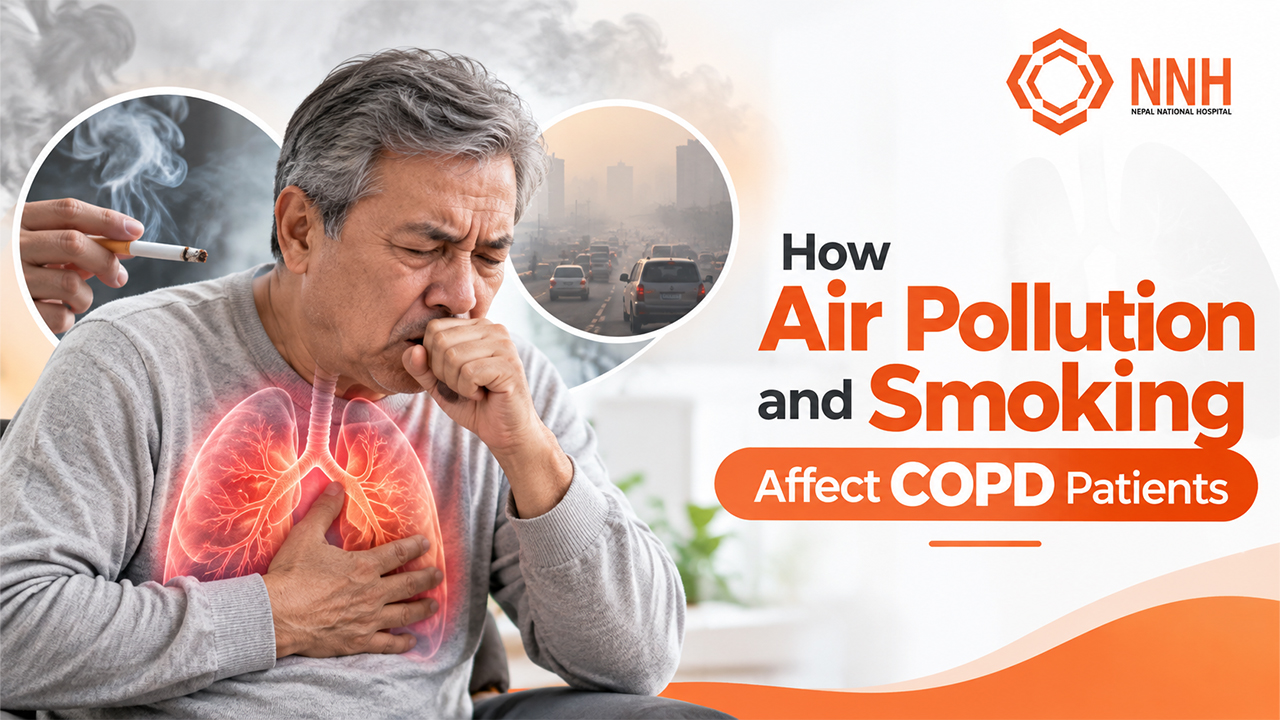
For someone living with chronic obstructive pulmonary disease (COPD), the air they breathe matters every day.
Cigarette smoke, secondhand smoke, traffic pollution, construction dust, cooking smoke, fumes and other airborne irritants can place additional stress on lungs that already have limited airflow. Some exposures contribute to the development of COPD over many years, while others can aggravate symptoms or contribute to a sudden COPD flare-up.
This is particularly relevant in Kathmandu, where traffic, road dust, construction activity, seasonal pollution and other sources can affect outdoor air quality. Household smoke and occupational exposure remain important issues elsewhere in Nepal as well.
The practical message is not that a person with COPD can avoid every pollutant. That may be impossible. The goal is to identify the largest avoidable exposures, reduce them where practical, continue appropriate COPD treatment and recognize when worsening breathing needs medical care.
Why Does Polluted Air Affect People With COPD?
COPD causes persistent limitation of airflow through the lungs. Common symptoms include breathlessness, chronic cough, sputum or phlegm production, wheezing and tiredness.
The World Health Organization identifies tobacco smoke and air pollution as major causes of COPD. Occupational dusts and fumes, household air pollution and other environmental exposures can also contribute.
Once COPD is present, polluted air may act as an additional irritant.
Fine particulate matter, commonly called PM2.5, is especially important because these particles are small enough to penetrate deep into the respiratory system. Air pollution also contains other particles and gases whose mixture varies according to traffic, industry, fuel combustion, weather and local conditions.
In a person with COPD, environmental irritation can be associated with increased coughing, wheezing, mucus production or breathlessness. Air pollution is also recognized as one possible trigger for COPD exacerbations.
That does not mean every bad breathing day is caused by pollution. Respiratory infections, heart problems, pneumonia, medication issues and other conditions can cause similar deterioration.
Smoking and COPD: The Most Important Avoidable Exposure
Cigarette smoking remains one of the strongest and best-established causes of COPD.
WHO reports that tobacco smoking accounts for more than 70% of COPD cases in high-income countries and approximately 30–40% in low- and middle-income countries, where household air pollution is also an important contributor.
Smoking repeatedly exposes the airways and lung tissue to toxic substances. Over time, these exposures contribute to inflammation and structural damage.
For someone who already has COPD, continuing to smoke is especially important because the lungs remain exposed to the factor that caused or contributed to much of the damage.
CDC guidance states that continued smoking leads to faster progression of lung damage than stopping smoking and that quitting benefits people who already have COPD.
Does quitting still help if you already have COPD?
Yes.
COPD-related lung damage cannot simply be reversed by stopping cigarettes, but quitting removes an important ongoing source of injury.
That means it is still worthwhile to stop even after years of smoking or after COPD has already been diagnosed.
Quitting can be difficult because nicotine dependence is a medical and behavioural problem, not simply a question of willpower. Some people benefit from counselling, structured cessation support or medically appropriate treatment.
Do not assume it is “too late” because COPD is already present.
Secondhand Smoke Matters Too
COPD patients should also reduce exposure to other people’s tobacco smoke.
Secondhand smoke adds respiratory irritants without providing any benefit to the person being exposed. CDC includes secondhand smoke among COPD risk factors and recommends avoiding cigarette smoke as part of risk reduction.
For a household with someone who has COPD, the most useful rule is straightforward:
keep the home and vehicle smoke-free.
Smoking next to a window, in another room or only when the patient is not present does not create the same protection as a genuinely smoke-free indoor environment.
How Does Outdoor Air Pollution Affect COPD?
Outdoor air pollution is not a single substance.
It may include particulate matter, vehicle exhaust, nitrogen dioxide, ozone, smoke and other pollutants. The mix changes by place, season, weather and source.
WHO states that outdoor and indoor air pollution can contribute to both the development and worsening of chronic respiratory diseases.
For people with COPD, poor-air-quality periods can increase respiratory irritation and may contribute to symptom worsening or exacerbations.
This makes exposure management useful.
It does not mean staying permanently indoors. Physical activity remains important for many COPD patients, and complete avoidance of outdoor air is neither possible nor desirable.
Instead, plan higher-exposure activities more intelligently.
Kathmandu Air Pollution and COPD
Kathmandu has documented air-quality challenges, and the World Health Organization has described air pollution in the Kathmandu Valley as an important public-health risk.
The useful question for a COPD patient is therefore not simply:
“Is Kathmandu polluted?”
It is:
“How polluted is the air today, how sensitive am I, and can I reduce unnecessary exposure?”
Kathmandu Metropolitan City now operates a live air-quality monitoring dashboard, and Nepal’s Department of Environment also publishes air-quality monitoring information. These tools can help patients and families decide whether to reschedule prolonged outdoor activity when air quality is particularly poor.
Nepal National Hospital also has a separate guide to protecting your lungs from Kathmandu air pollution.
Dust and COPD: Why Construction and Workplace Exposure Matter
Dust is another important issue.
The word “dust” covers many different particles. Everyday household dust is not the same exposure as cement dust, silica-containing construction dust, industrial dust or smoke particles.
WHO identifies occupational exposure to dust and fumes as an important chronic-respiratory-disease risk, particularly in industries and informal work involving construction, mining, agriculture and similar exposures.
Someone with COPD may notice more coughing, wheezing or breathlessness in a dusty workplace or around heavy construction.
Practical exposure reduction can include changing work practices, controlling dust at its source, improving ventilation and using appropriate occupational respiratory protection when required.
Workplace exposure should not simply be treated as “normal because of the job.” If symptoms repeatedly become worse at work or around a particular dust or chemical, tell your clinician what you are exposed to and how often.
Household Air Pollution and COPD
For Nepal, outdoor pollution is only part of the story.
Household air pollution can be produced by burning wood, crop waste, charcoal, dung, coal, kerosene and other polluting fuels in inefficient stoves or poorly ventilated spaces.
WHO specifically identifies household air pollution as a cause of COPD and other serious diseases.
This matters because a person can have substantial lifetime smoke exposure even without having smoked cigarettes.
Someone being assessed for COPD should therefore tell the clinician about:
- current and previous cigarette or tobacco use
- secondhand smoke
- years of cooking around wood or biomass smoke
- occupational dust or fumes
- traffic or heavy pollution exposure and
- previous significant respiratory illnesses.
Exposure history can provide important context when respiratory symptoms and lung-function results are interpreted.
What About Incense, Cleaning Sprays and Indoor Irritants?
Not every indoor irritant causes COPD, but some can aggravate respiratory symptoms in susceptible people.
Strong cleaning products, sprays, fumes, incense, smoke, air fresheners and other airborne irritants may trigger coughing or breathing discomfort.
The American Lung Association recommends identifying COPD triggers and reducing exposure to smoke, strong odours, dust, chemicals and fumes where possible.
The goal is not to make a home chemically sterile. It is to remove unnecessary irritants and maintain reasonably clean indoor air.
Does Air Conditioning Make COPD Worse?
Air conditioning does not automatically worsen COPD, and it does not cause COPD simply because cooled air is being used.
For some people with chronic lung disease, air conditioning can actually make indoor conditions more tolerable during hot or humid weather. The American Lung Association specifically recommends air conditioning as one strategy during hot or humid conditions for people whose COPD symptoms are triggered by weather.
The problem is usually not “AC versus no AC.” What matters is the condition of the indoor environment.
Potential issues include very cold or dry air in a sensitive person, dirty filters, accumulated dust, mould or mildew, poor ventilation and sudden movement between extreme indoor and outdoor temperatures.
Cold, dry air can worsen cough, wheezing or shortness of breath in some people with chronic lung disease.
If air conditioning appears to trigger symptoms, practical steps include keeping the temperature comfortable rather than extremely cold, maintaining filters and equipment, addressing mould or dampness and discussing recurrent symptoms with a clinician.
Do not assume that the air conditioner itself means the COPD is deteriorating.
How Can COPD Patients Reduce Pollution Exposure?
Start with the exposures that are both significant and realistically changeable.
1. Stop smoking
For a smoker with COPD, this is one of the most important interventions available.
Avoiding a polluted road while continuing to smoke cigarettes does not address the largest controllable exposure.
2. Keep indoor spaces smoke-free
That includes cigarettes, other tobacco smoke and avoidable combustion smoke.
3. Check air quality before prolonged outdoor activity
Use an official AQI source when possible.
Poor air quality does not necessarily mean a person must remain indoors all day. It can mean changing the time, intensity or location of outdoor activity.
4. Avoid unnecessarily polluted routes
When practical, reduce prolonged time next to congested traffic, active construction, waste burning or visible smoke.
5. Reduce indoor particle sources
Avoid unnecessary burning, smoke and strongly irritating sprays.
6. Address household cooking smoke
Cleaner fuels, better ventilation and improved cooking technologies can reduce household-air-pollution exposure.
7. Manage workplace exposure
If dust or fumes are unavoidable because of work, proper engineering controls and occupational safety measures are preferable to relying entirely on a mask.
8. Keep taking prescribed COPD treatment
Exposure reduction complements medical treatment. It does not replace prescribed inhalers, vaccination advice, pulmonary rehabilitation where appropriate or other individualized COPD management.
Nepal National Hospital’s existing COPD treatment guide explains the broader treatment pathway.
Should COPD Patients Wear an N95 Mask During Pollution?
A properly fitting particulate respirator can reduce exposure to airborne particles.
CDC/NIOSH explains that standardized respirators such as N95s filter particulate matter when properly fitted, but they do not remove every type of harmful gas or vapour.
There is an important COPD-specific limitation:
a tight-fitting respirator can make breathing feel more difficult.
CDC advises people with heart or lung conditions to ask their healthcare professional before using a respirator if breathing difficulty is a concern.
A mask also should not create false confidence.
Wearing an N95 while spending unnecessary time beside heavy traffic or dust does not make the exposure disappear. Avoidance or reduction of the pollution source remains the first strategy when practical.
Loose cloth masks and ordinary surgical masks also should not be assumed to provide the same protection against fine particulate pollution as a well-fitting certified particulate respirator.
Can Pollution Trigger a COPD Flare-Up?
Yes, it can.
A COPD exacerbation is a noticeable worsening beyond the person’s usual day-to-day symptoms. Respiratory infections are common triggers, but air pollution and other inhaled irritants can also contribute.
Possible changes include:
- greater-than-usual breathlessness
- increased coughing
- increased sputum
- a change in sputum characteristics
- worsening wheeze
- reduced ability to walk or perform normal activities or
- greater need for symptom-relief medication.
The exact action to take should be based on the patient’s individualized COPD plan.
Do not automatically start antibiotics, oral steroids, oxygen or additional medicine because pollution is high unless these actions are part of instructions from the treating clinician.
When Should a COPD Patient Seek Medical Help?
Contact a healthcare professional promptly when COPD symptoms are clearly worse than usual, particularly when the change is persistent or interfering significantly with ordinary activities.
Urgent or emergency assessment may be necessary when breathing becomes severe or rapidly worse, the person struggles to speak or move because of breathlessness, becomes unusually sleepy or confused, develops significant chest pain, has blue or grey discoloration around the lips or face, or otherwise appears seriously unwell.
A home oxygen-saturation reading can provide useful information in some circumstances, but it should not replace clinical judgment. A person who looks seriously ill needs medical assessment even when a consumer device appears reassuring.
Can Pollution Symptoms Mean Something Other Than COPD?
Yes.
Breathlessness and coughing are not specific to COPD.
Asthma, pneumonia, tuberculosis, heart disease, anaemia, respiratory infection and other conditions can produce overlapping symptoms.
People who repeatedly blame breathlessness on “Kathmandu dust” or “smoking” without a confirmed diagnosis may delay evaluation of another medical problem.
COPD itself should not be diagnosed from symptoms alone.
Spirometry is central to confirming persistent airflow obstruction when COPD is suspected in the appropriate clinical context. Nepal National Hospital has a separate guide explaining pulmonary function testing in Kathmandu.
COPD and Pulmonology Care in Kathmandu
People with established COPD may need review when symptoms become more frequent, inhalers appear less effective, flare-ups recur or environmental exposures are difficult to manage.
People without a confirmed diagnosis may need assessment when chronic cough, phlegm, wheezing or unexplained breathlessness persists particularly when there is a history of smoking, household smoke, workplace dust or other significant inhaled exposures.
Nepal National Hospital provides pulmonology through its Department of Medicine in Kalanki, Kathmandu, and currently lists a pulmonologist within that service. Its respiratory information also describes pulmonary-function testing and diagnostic support.
A respiratory consultation should help answer three different questions:
What condition is causing the symptoms?
Which exposures are contributing?
What treatment and exposure-reduction plan is appropriate for this individual?
For broader respiratory-care information, see Nepal National Hospital’s pulmonology services guide.
Key Takeaways
Smoking and air pollution are both important COPD risks, but they are not identical exposures.
For a COPD patient who still smokes, quitting smoking should remain a major priority.
Outdoor pollution, household cooking smoke, secondhand smoke, dust and occupational fumes can also contribute to respiratory symptoms and COPD risk.
Poor air quality can worsen COPD symptoms and may contribute to exacerbations.
Air conditioning itself does not cause COPD. Temperature, humidity, cleanliness, mould, dust and individual sensitivity matter more.
A certified particulate respirator can reduce particle exposure, but fit and limitations matter, and some people with COPD may find tight-fitting respirators difficult to tolerate.
Exposure reduction should complement not replace appropriate COPD treatment.
Persistent or worsening breathing symptoms should not automatically be blamed on pollution. Proper clinical assessment can determine whether COPD, infection, asthma, heart disease or another problem is contributing.
For persistent cough, wheezing, breathlessness or established COPD requiring review, patients can contact Nepal National Hospital to ask about current pulmonology consultation availability.
Medical notice: This article provides general health information. It cannot diagnose COPD, determine the cause of an individual’s symptoms or prescribe an individual treatment plan. Severe or rapidly worsening breathing difficulty requires urgent medical assessment.
FAQs
Can air pollution cause COPD even if I have never smoked?
Yes. Smoking is a major COPD cause, but it is not the only one. WHO identifies household air pollution and other environmental exposures as important COPD risk factors, particularly in lower- and middle-income countries.
Is road dust dangerous for COPD patients?
Heavy particle exposure can aggravate respiratory symptoms. Occupational and environmental dust exposure can also contribute to chronic respiratory disease. The specific risk depends on what the dust contains, exposure intensity and duration.
Is AC good or bad for COPD?
Neither universally. Air conditioning may make hot or humid conditions easier to tolerate, while very cold/dry air, dirty filters, mould or accumulated dust can aggravate some people’s symptoms.
What mask is best for COPD patients during air pollution?
A well-fitting certified particulate respirator such as an N95 can reduce particle exposure, but it does not remove all gases or vapours. Because tight-fitting respirators can make breathing harder, people with lung disease should discuss their suitability with a clinician if they have difficulty tolerating one.
Should I exercise outside if pollution is high?
Physical activity remains valuable, but exposure can often be reduced by adjusting timing, location and intensity when air quality is poor. COPD patients should follow their individualized exercise/pulmonary-rehabilitation advice rather than stopping activity indefinitely.