
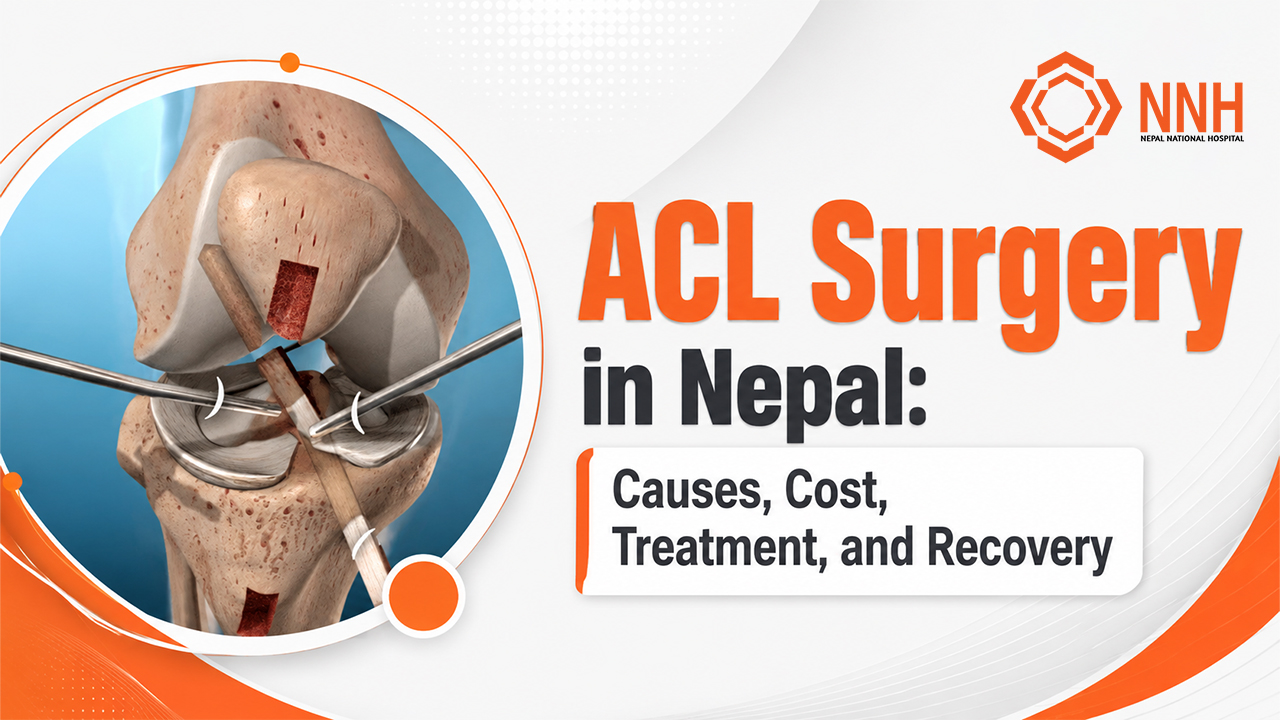
If you are searching for ACL surgery in Nepal, you may already be dealing with knee pain, swelling, instability, or a sports injury that has affected your walking, work, or daily life. An ACL tear is a common knee ligament injury, especially in people who play football, basketball, volleyball, futsal, or do activities that involve sudden turning, jumping, or stopping. ACL tears often happen during pivoting, cutting, or landing movements.
The right treatment depends on the severity of the tear, your age, activity level, knee stability, associated meniscus injury, and recovery goals. Some patients improve with physiotherapy, while others need arthroscopic ACL reconstruction.
At Nepal National Hospital, Kathmandu, patients can consult the orthopedic department for knee injuries, sports injuries, trauma care, arthroscopy procedures, imaging, and rehabilitation support.
When Is ACL Surgery Needed?
ACL surgery is usually considered when a complete ACL tear causes repeated knee “giving way,” when the patient wants to return to pivoting sports, or when there are associated injuries such as meniscus damage.
Not every ACL tear requires surgery. AAOS states that non-operative treatment may be considered first in selected acute isolated ACL tears, while surgery may be appropriate within a suitable timeframe when instability or activity demands make reconstruction necessary.
A proper orthopedic evaluation is important before deciding.
What Is the ACL?
The ACL, or anterior cruciate ligament, is one of the main stabilizing ligaments inside the knee. It helps control forward movement and rotation of the shin bone in relation to the thigh bone.
When the ACL tears, the knee may feel unstable during running, turning, climbing stairs, or changing direction. Some people can walk after the injury, but still feel that the knee is not trustworthy during active movement.
What Causes an ACL Tear?
The most common ACL cause is a sudden twisting or pivoting movement. It can also happen during direct trauma, a fall, road accident, or awkward landing.
ACL injuries commonly happen during movements such as pivoting, cutting, or jumping with the leg straightened on landing, especially in sports like football, basketball, volleyball, and soccer.
Common ACL Tear Causes
| Cause | How It Happens |
| Sudden pivoting | Foot stays planted while the body turns |
| Awkward landing | Knee collapses inward after a jump |
| Sudden stop | Rapid deceleration stresses the ligament |
| Direct collision | A blow to the knee during sports or accident |
| Road traffic injury | Twisting force during a fall or crash |
| Weak hip/thigh control | Poor landing mechanics increase knee strain |
In a Nepal-based study of arthroscopic ACL reconstruction patients, road traffic accidents were the most common cause, followed by sports injuries and household injuries.
What Are the Symptoms of an ACL Tear?
Many patients describe a “pop” feeling at the time of injury. Swelling often appears within a few hours. The knee may feel unstable, especially while turning or walking on uneven ground.
Common symptoms include:
| Symptom | What It May Mean |
| Sudden knee pain | Acute ligament injury or associated damage |
| Swelling | Internal bleeding or inflammation after injury |
| Giving way | Knee instability from ACL tear |
| Difficulty walking | Pain, swelling, or loss of control |
| Locking or clicking | Possible meniscus injury |
| Fear while turning | Rotational instability |
In the Nepal Orthopedic Association Journal study, pain, swelling, giving way, clicking, and locking were common presenting complaints among ACL reconstruction patients.
How Is an ACL Tear Diagnosed?
An orthopedic doctor usually starts with a history and physical examination. The doctor may check swelling, range of motion, tenderness, knee stability, and signs of meniscus injury.
MRI is commonly used to confirm ACL injury and detect associated damage to the meniscus, cartilage, or other ligaments.
Diagnosis Pathway
| Step | Purpose |
| Clinical history | Understand injury mechanism and symptoms |
| Knee examination | Check ligament stability and movement |
| X-ray | Rule out fracture or bone injury |
| MRI | Confirm ACL tear and associated injuries |
| Treatment planning | Decide physiotherapy, bracing, or surgery |
A correct diagnosis matters because ACL treatment is not the same for every patient.
ACL Surgery in Nepal: What Happens During Reconstruction?
Most ACL surgeries today are done using arthroscopy, also called keyhole surgery. In ACL reconstruction, the torn ligament is replaced with a tendon graft.
Nepal National Hospital describes ACL reconstruction as a minimally invasive procedure using small incisions, bone tunnels, and screws or buttons to secure the new ligament.
Common Steps in ACL Reconstruction
| Step | What Happens |
| Arthroscopy | A small camera is inserted into the knee |
| Graft preparation | A tendon graft is prepared |
| Tunnel creation | Small tunnels are made in the femur and tibia |
| Graft placement | The graft is positioned like the original ACL |
| Fixation | Screws, buttons, or implants secure the graft |
| Rehabilitation | Physiotherapy begins after surgery |
The graft may come from the patient’s hamstring tendon, patellar tendon, or quadriceps tendon. The best graft choice depends on age, sport, activity level, surgeon preference, and knee condition.
Is Surgery Always Needed for an ACL Tear?
No. Some partial tears and low-demand patients may do well with rehabilitation, activity modification, and strengthening.
Surgery is more commonly advised when:
| Situation | Why Surgery May Be Considered |
| Complete ACL tear | Knee may remain unstable |
| Repeated giving way | Risk of further meniscus or cartilage injury |
| Athlete or active patient | Pivoting sports need knee stability |
| Manual work | Heavy physical work may require stable knee |
| Meniscus injury | Combined repair may be needed |
| Failed physiotherapy | Instability continues despite rehab |
Research has shown that some patients can start with structured rehabilitation and only choose surgery later if instability continues. A BMJ randomized trial found that early ACL reconstruction was not clearly superior to rehabilitation with optional delayed surgery at five years in selected young active adults.
This is why the decision should be personalized.
ACL Surgery Cost in Nepal: What Should Patients Expect?
The ACL surgery cost in Nepal varies depending on the hospital, surgeon, graft type, implant choice, MRI and lab tests, anesthesia, bed category, medicines, physiotherapy, and whether meniscus repair is also needed.
There is no single fixed national price for every patient.
For context, Nepal APF Hospital’s public price list places ACL reconstruction under a P1 orthopedic operative procedure category, and its P1 procedure charge is listed as NPR 20,000. However, this is a procedure charge, not the full package cost. The final bill may include implants, investigations, anesthesia, operation theatre charges, hospital stay, medicines, braces, and rehabilitation.
What Affects ACL Surgery Cost?
| Cost Factor | Why It Changes the Price |
| Hospital type | Private, public, and specialized hospitals have different pricing |
| Surgeon and team | Specialist care and operation complexity vary |
| Arthroscopy equipment | Keyhole surgery needs specialized tools |
| Implants | Screws, buttons, anchors, and fixation devices add cost |
| Graft type | Hamstring, patellar, quadriceps, or donor graft may differ |
| Meniscus repair | Combined procedures increase cost |
| Room category | General ward, cabin, or private room changes billing |
| Physiotherapy | Rehab is essential and continues for months |
Patients should request a written estimate before surgery. The estimate should mention what is included and what may be charged separately.
Why Is ACL Surgery Costly?
ACL reconstruction is costly because it is not just a simple ligament stitch. It usually requires arthroscopic equipment, trained orthopedic surgeons, anesthesia support, operation theatre setup, implants, graft preparation, post-operative medicines, follow-up, and long-term physiotherapy.
A low-cost operation without proper rehabilitation may not give the expected result. Recovery depends on both surgical technique and disciplined rehab.
Recovery Timeline After ACL Surgery
Recovery after ACL reconstruction takes time. Many patients walk with support early, but return to running, sports, or heavy work happens gradually.
Nepal Orthopaedic Hospital notes that physical therapy is crucial, often lasting 4–6 months or more, and return to high-impact sport may take 9–12 months.
General ACL Recovery Timeline
| Time After Surgery | Common Goal |
| 0–2 weeks | Control swelling, regain knee extension, safe walking |
| 2–6 weeks | Improve range of motion and basic strength |
| 6–12 weeks | Build balance, strength, and walking confidence |
| 3–6 months | Jogging and progressive strengthening if cleared |
| 6–9 months | Sport-specific drills may begin |
| 9–12 months | Return to pivoting sport if strength and control are adequate |
Return to sport should not be based on time alone. Strength, balance, confidence, knee control, and surgeon/physiotherapist clearance matter.
How Successful Is ACL Surgery?
ACL reconstruction has good outcomes for many patients, but it is not 100% successful for everyone.
A Nepal based study published in the Nepal Orthopedic Association Journal found that 82% of patients had excellent-to-good functional outcomes, 93% had normal-to-near-normal IKDC scores, and 79% returned to pre-injury level after arthroscopic ACL reconstruction with hamstring autograft. The study was small, so results should be interpreted carefully.
In elite athletes, a systematic review found that 83% returned to sport after ACL reconstruction, while 5.2% sustained graft rupture.
Success depends on:
| Factor | Why It Matters |
| Correct diagnosis | Associated injuries must not be missed |
| Surgical technique | Graft position and fixation affect stability |
| Rehabilitation | Strength and movement control are essential |
| Timing of return | Returning too early may increase reinjury risk |
| Patient goals | Daily walking and elite sports need different recovery levels |
| Meniscus/cartilage health | Additional damage can affect long-term results |
Young athletes who return to sport have a higher risk of second ACL injury; one systematic review reported a secondary ACL injury rate of 23% in athletes younger than 25 who returned to sport.
Choosing an Orthopedic Hospital in Nepal for ACL Reconstruction
When choosing an orthopedic hospital in Nepal for ACL surgery, look beyond price alone. ACL reconstruction needs diagnosis, surgery, anesthesia, implants, physiotherapy, and follow-up.
Nepal National Hospital’s orthopedic department lists orthopedic and trauma surgeons, including senior orthopedic and spine surgery care.The hospital also describes orthopedic services such as arthroscopy procedures, sports injury management, trauma care, imaging, MRI/CT services, physiotherapy, and rehabilitation.
What to Ask Before ACL Surgery
| Question | Why It Helps |
| Is my ACL tear complete or partial? | Treatment differs by injury severity |
| Do I have meniscus or cartilage damage? | Combined injuries change the plan |
| What graft will be used? | Graft choice affects recovery and sport goals |
| What implants are included? | Helps understand cost |
| How many days do I need to stay? | Helps plan budget and family support |
| When will physiotherapy start? | Rehab is key to outcome |
| When can I return to work or sport? | Sets realistic expectations |
| What are the risks? | Helps make informed consent |
A good hospital should explain both benefits and limitations clearly.
Risks and Limitations of ACL Surgery
ACL surgery is generally safe when done by trained orthopedic surgeons, but every surgery has risks.
Possible risks include infection, stiffness, pain, graft failure, blood clots, numbness around the incision, persistent instability, or difficulty returning to previous sports level.
In the Nepal Orthopedic Association Journal study, some patients had mild-to-moderate pain, numbness, superficial infection, grade I laxity, or incomplete range of motion at follow-up.
This does not mean surgery should be avoided. It means patients should understand recovery honestly.
Can ACL Tears Be Prevented?
Not all ACL injuries can be prevented, but risk can be reduced. Prevention focuses on strength, landing technique, balance, and neuromuscular control.
Nepal National Hospital recommends jumping, landing, stopping, and moving with the knees aligned over the feet, avoiding inward knee collapse, strengthening hips and thighs, and warming up before games or practice.
Athletes in Nepal who play futsal, football, basketball, volleyball, badminton, or martial arts can benefit from structured warm-up and injury-prevention training.
Why Choose Nepal National Hospital for ACL Consultation?
For patients looking for ACL treatment or ACL reconstruction in Kathmandu, Nepal National Hospital can be considered because it provides orthopedic care, sports injury management, arthroscopy-related services, imaging support, and rehabilitation under one hospital system.
The hospital’s orthopedic department includes multiple orthopedic doctors and surgeons, which is important for evaluation, surgical planning, and follow-up care.
For the best result, patients should bring previous MRI reports, X-rays, prescriptions, and injury details during consultation.
FAQs About ACL Surgery in Nepal
How does an ACL tear?
An ACL usually tears when the knee twists suddenly, the foot stays planted while the body turns, or the person lands awkwardly from a jump. It may also tear from road accidents or direct sports collision.
How much does it cost for ACL surgery in Nepal?
The cost varies by hospital, implant, graft, room type, anesthesia, tests, medicines, and physiotherapy. A public Nepal APF Hospital list places ACL reconstruction under a P1 procedure charge of NPR 20,000, but the full package is higher after implants and hospital-related costs. (Nepal APF Hospital)
Is ACL surgery 100% successful?
No. ACL surgery has good success rates for many patients, but it is not 100% guaranteed. Outcomes depend on surgery quality, graft healing, rehabilitation, return-to-sport timing, and associated knee damage.
Is ACL surgery permanent?
ACL reconstruction is designed to restore long-term knee stability, but the graft can still stretch or tear after another injury. Proper rehab and safe return to sport reduce reinjury risk.
Why is ACL surgery costly?
ACL surgery is costly because it involves arthroscopic equipment, operation theatre charges, anesthesia, implants, graft preparation, hospital stay, medicines, follow-up visits, and physiotherapy.
Which is the best hospital for ACL reconstruction in Kathmandu?
The best hospital depends on the surgeon’s experience, arthroscopy facilities, imaging, implant quality, physiotherapy support, and follow-up care. Nepal National Hospital is a strong option for orthopedic consultation in Kathmandu because it offers orthopedic specialists, arthroscopy procedures, imaging, and rehabilitation services.
Written by: Nepal National Hospital Editorial Team
Medically reviewed by: Orthopedic Department, Nepal National Hospital, Kathmandu, Nepal
Nepal National Hospital provides orthopedic consultation, trauma care, sports injury management, arthroscopy-related services, imaging, and rehabilitation support in Kathmandu. This article is for educational purposes only and should not replace a consultation with a qualified orthopedic surgeon.