
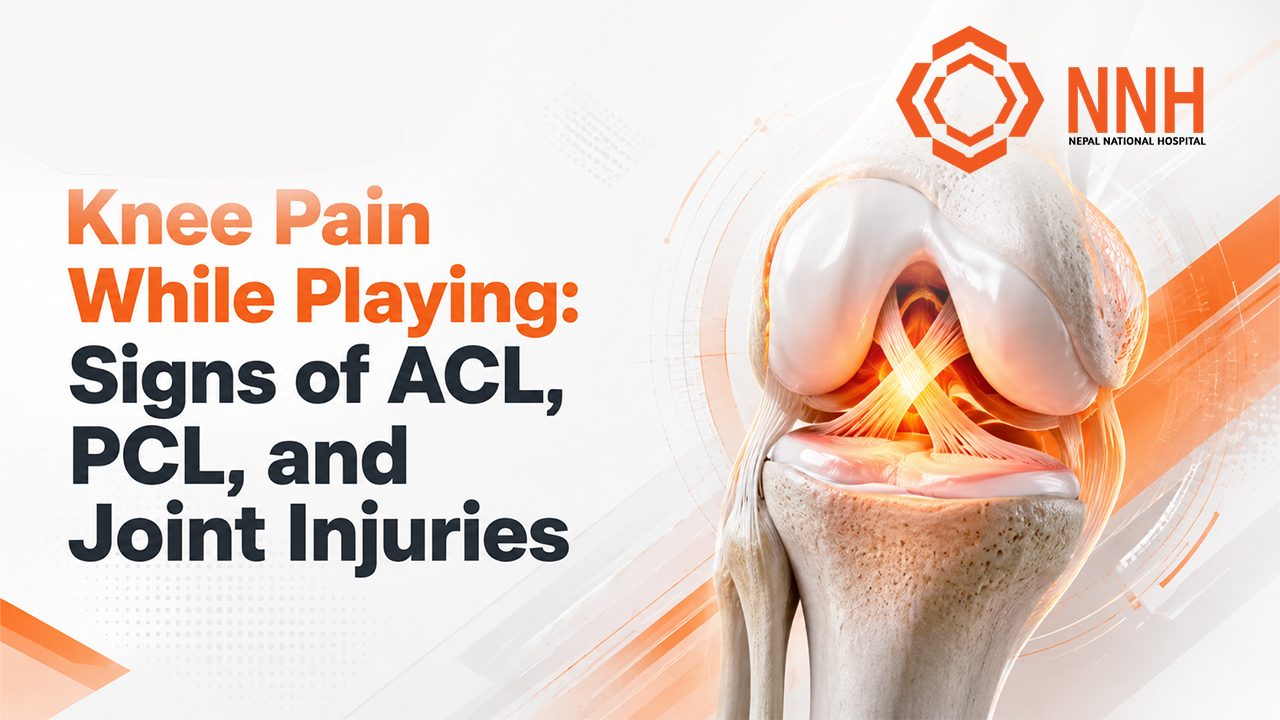
Knee Pain While Playing: Signs of ACL, PCL, and Joint Injuries is an important topic for athletes, students, runners, football players, and anyone who feels knee pain during sports. Pain, swelling, a popping sound, knee instability, or sudden twisting may be signs of ligament injury, including ACL or PCL damage.
Mild knee pain can come from muscle strain or overuse. But sudden knee pain after twisting, landing badly, or being hit during sports should not be ignored. Early diagnosis helps prevent long-term stiffness, repeated injury, and delayed return to activity.
Nepal National Hospital provides orthopedic care, emergency support, arthroscopy procedures, trauma care, and physiotherapy services for bone, joint, and sports-related injuries.
What Causes Knee Pain While Playing?
Pain in knee while playing or during physical activities can happen because of sudden injury, repeated stress, poor movement control, weak muscles, or an underlying joint problem.
In sports, the knee has to absorb force from running, jumping, stopping, turning, and landing. If the knee twists while the foot stays planted, ligaments such as the ACL or PCL can stretch or tear.
Common causes include:
| Cause | What happens | Common symptoms |
| ACL injury | Knee twists or gives way during pivoting | Pop sound, swelling, instability |
| PCL injury | Direct blow to front of knee or fall on bent knee | Pain, swelling, stiffness, trouble walking |
| Meniscus injury | Cartilage gets pinched or torn | Locking, clicking, pain with bending |
| Patellar tendon strain | Overuse from jumping or running | Front knee pain |
| Muscle imbalance | Weak hip, thigh, or calf muscles | Pain during running or landing |
| Arthritis or cartilage wear | Joint surface irritation | Stiffness, swelling, pain after activity |
The ACL and PCL are two major ligaments inside the knee. Cleveland Clinic explains that the ACL and PCL cross inside the knee joint and help stabilize the knee during movement.
What Is an ACL Injury?
The ACL, or anterior cruciate ligament, helps stop the shinbone from sliding too far forward and helps control twisting movements.
ACL injuries are common in sports that involve sudden stops, jumping, landing, and direction changes. Football, basketball, volleyball, futsal, running, and martial arts can all place stress on the ACL.
AAOS describes ACL tears as one of the most common knee injuries and notes that they often happen during pivoting, cutting, or landing movements.
Common ACL Injury Symptoms
The most common ACL injury symptoms include:
- A popping sound or popping feeling in the knee
- Sudden pain after twisting or landing
- Rapid swelling within hours
- Knee instability or “giving way”
- Difficulty walking or continuing the game
- Pain while bearing weight
- Loss of full knee movement
AAOS states that people with ACL injury may hear a pop and feel the knee give out. Mayo Clinic also notes that ACL injury may cause swelling, instability, and pain that makes weight-bearing difficult.
What Does ACL Pain Feel Like?
ACL pain often starts suddenly. Many people remember the exact movement that caused it, such as landing from a jump, changing direction, or twisting the knee.
The pain may feel sharp at first. After that, swelling and stiffness can make the knee feel heavy, tight, or unstable.
Some people can walk after an ACL injury, but that does not mean the ligament is fine. The knee may still be unstable and at risk of further injury, especially if the person returns to sports too early.
What Is a PCL Injury?
The PCL, or posterior cruciate ligament, helps stop the shinbone from moving too far backward.
PCL injuries are less common than ACL injuries, but they can still happen during sports, falls, or accidents. A common mechanism is a direct blow to the front of the knee while the knee is bent.
Common PCL Injury Symptoms
A typical PCL injury symptom may include:
- Pain deep inside or at the back of the knee
- Swelling that develops after injury
- Knee stiffness
- Difficulty walking
- Trouble going downstairs
- A feeling that the knee is unstable
- Limping after the injury
AAOS lists PCL injury symptoms such as pain, swelling, stiffness, limping, difficulty walking, and a feeling that the knee may give out. Cleveland Clinic also notes that PCL injury can cause worsening pain, inflammation, instability, stiffness, and trouble going downstairs.
ACL vs PCL Injury: Key Differences
ACL and PCL injuries can feel similar, but their causes and treatment plans may differ.
| Feature | ACL Injury | PCL Injury |
| Common cause | Twisting, pivoting, sudden stop, awkward landing | Direct blow to bent knee, fall, dashboard-type injury |
| Pain location | Often central or deep knee pain | Often deep or back-of-knee pain |
| Swelling | Often rapid | May develop steadily |
| Instability | Common, especially with pivoting | May feel unstable or weak |
| Sports impact | Often affects cutting and jumping sports | May affect walking, stairs, running, and squatting |
| Surgery | Often considered for active patients with complete tears | Many isolated PCL tears may be treated without surgery |
| Rehab | Usually several months | Depends on grade; mild cases may recover faster |
Neither injury should be self-diagnosed. A doctor may use physical examination, X-ray, MRI, and functional tests to confirm the injury.
When Is Knee Pain While Playing Serious?
You should stop playing and seek medical care if the knee pain follows a sudden twist, fall, collision, or awkward landing.
Warning signs include:
- A pop sound during injury
- Sudden swelling
- Severe pain
- Knee giving way
- Inability to bear weight
- Knee locking
- Visible deformity
- Fever, redness, or heat around the knee
Mayo Clinic advises medical evaluation when knee pain includes inability to bear weight, marked swelling, instability, inability to fully bend or straighten the knee, deformity, fever with redness and swelling, or severe injury-related pain.
NHS also recommends urgent advice if the knee is very painful, badly swollen, changed in shape, cannot bear weight, locks, gives way, or has redness and heat with fever-like symptoms.
What Should You Do Immediately After Knee Pain During Sports?
The first step is to stop playing. Continuing the match can worsen a ligament, cartilage, or joint injury.
For a new injury:
- Stop activity immediately.
- Avoid forcing the knee to bend or twist.
- Apply ice wrapped in cloth.
- Keep the leg elevated if swelling begins.
- Avoid massage, heat, or aggressive stretching in the first stage.
- Visit an orthopedic doctor if pain, swelling, or instability continues.
This is especially important if the knee twisted, made a popping sound, or became swollen quickly.
How Is ACL or PCL Injury Diagnosed?
A proper diagnosis starts with a history and physical exam. The doctor will ask how the injury happened, whether there was a pop, when swelling started, and whether the knee feels unstable.
Diagnosis may include:
| Test | Purpose |
| Physical examination | Checks swelling, movement, tenderness, and stability |
| Lachman/anterior drawer test | Helps assess ACL stability |
| Posterior drawer test | Helps assess PCL stability |
| X-ray | Checks fracture or bone injury |
| MRI | Shows ligament, meniscus, cartilage, and soft tissue damage |
| Functional assessment | Checks walking, balance, strength, and movement control |
AAOS notes that many ligament injuries can be diagnosed through a thorough knee examination, while imaging may help confirm related injuries.
PCL Injury Treatment: What Are the Options?
PCL injury treatment depends on the grade of injury, knee stability, associated injuries, pain level, and activity goals.
Mild isolated PCL injuries may improve with non-surgical treatment. More severe injuries, combined ligament injuries, or persistent instability may require surgical evaluation.
Non-Surgical PCL Treatment May Include
- Rest from sports
- Ice and swelling control
- Knee brace
- Physiotherapy
- Strengthening exercises
- Gradual return-to-sport plan
- Follow-up assessment
UCSF Health states that simple PCL tears are usually treated with physical therapy rather than surgery, and bracing may be used at first.
Surgical PCL Treatment May Be Considered When
- The PCL tear is severe
- Other ligaments are also injured
- The knee remains unstable
- The person has high athletic demands
- Non-surgical care does not restore function
Cleveland Clinic notes that mild PCL injuries may heal in about 10 days, while recovery after PCL surgery may take about six to nine months.
ACL Treatment: Does Every ACL Tear Need Surgery?
Not every ACL injury needs surgery. Treatment depends on age, activity level, knee instability, tear severity, other injuries, and goals.
Non-Surgical ACL Treatment May Be Suitable For
- Partial ACL tears with good stability
- Less active patients
- People willing to modify activities
- Patients without repeated giving-way episodes
- Cases where physiotherapy restores good function
ACL Surgery May Be Considered For
- Complete ACL tear with instability
- Athletes wanting to return to pivoting sports
- Combined meniscus or ligament injury
- Repeated knee giving way
- High-demand work or sports activity
ACL treatment may include rest and rehabilitation exercises or surgery to replace the torn ligament followed by rehabilitation, depending on severity.
How Long Does ACL Recovery Take?
ACL recovery depends on whether treatment is surgical or non-surgical, the grade of tear, associated meniscus injury, strength, swelling control, and rehab progress.
For ACL reconstruction, return to unrestricted competition or high-impact sport is often around nine months or more, depending on medical clearance and functional testing. Many athletes may return to unrestricted competition by about nine months.
Research also shows that returning to knee-strenuous sport nine months after ACL reconstruction may increase the risk of a second ACL injury.
A safe return is not based only on time. It should also include:
- Full knee range of motion
- Minimal swelling
- Good quadriceps and hamstring strength
- Good balance and landing control
- Confidence during sport-specific movement
- Doctor or physiotherapist clearance
Can You Recover 100% From ACL Injury?
Many people return to sport after ACL injury, but “100% recovery” depends on the individual. Recovery is influenced by the type of tear, treatment quality, physiotherapy consistency, mental confidence, muscle strength, and whether there are meniscus or cartilage injuries.
A review reported that about 81% of people returned to some form of sport after ACL reconstruction, but return to the exact previous level may be lower.
This means recovery can be excellent, but it should be measured realistically. The goal is not just pain relief. The goal is a stable, strong, confident knee that can tolerate the demands of daily life or sport.
Can a Torn ACL Heal Without Surgery?
A torn ACL usually does not heal like a simple muscle strain. Some partial tears or low-demand cases can function well with rehabilitation, but complete ACL tears often leave the knee unstable, especially during pivoting sports.
Non-surgical ACL care may work for selected patients. However, active players with repeated giving-way episodes often need orthopedic evaluation for reconstruction.
The right decision should be made after examination, MRI findings, activity goals, and discussion with an orthopedic specialist.
How Long Does a PCL Injury Take to Heal?
PCL healing time depends on severity.
| PCL injury type | Possible recovery range |
| Mild sprain | Days to a few weeks |
| Moderate tear | Several weeks to months |
| Severe tear or surgery | Around 6–9 months or longer |
Cleveland Clinic states that mild PCL injuries may heal in about 10 days, while recovery after surgery can take about six to nine months. UCSF Health also notes that recovery may range from a few weeks to a few months depending on injury severity.
Is PCL Worse Than ACL?
PCL is not always worse than ACL. In many isolated cases, PCL injuries may be managed without surgery. ACL injuries are more common in sports and more often cause instability during pivoting, cutting, and jumping movements.
However, a severe PCL tear with other ligament damage can be serious. The severity depends on the grade of injury, knee stability, and whether other structures are damaged.
So the better question is not “which is worse?” It is “how unstable is the knee, and what structures are injured?”
Can a Torn PCL Heal Without Surgery?
Yes, some torn PCL injuries can heal or become functional without surgery, especially isolated low grade injuries.
Non-surgical care may include bracing, swelling control, physiotherapy, strengthening, and gradual return to activity. Surgery is more likely if the injury is severe, combined with other ligament injuries, or causes ongoing instability.
A doctor should evaluate the injury before deciding.
How to Stop Knee Pain When Playing Sports
Prevention is not perfect, but many knee injuries can be reduced with better movement habits, strength, and training load control.
Helpful steps include:
| Prevention step | Why it helps |
| Warm up properly | Prepares muscles and joints for movement |
| Strengthen hips and thighs | Reduces stress on the knee |
| Practice landing technique | Helps avoid knee collapse inward |
| Improve balance | Supports knee control during direction changes |
| Avoid sudden training spikes | Reduces overload injuries |
| Wear proper footwear | Improves grip and support |
| Do not play through swelling | Prevents worsening injury |
| Follow rehab after injury | Reduces reinjury risk |
AAOS states that strengthening muscles that support the knee helps reduce stress on the knee joint and absorb shock.
Research also suggests that neuromuscular training can reduce ACL injury risk, especially when programs include strength, balance, plyometrics, and movement-control training.
Role of Physiotherapy in ACL and PCL Recovery
Physiotherapy is important whether the injury is treated with or without surgery.
A good rehab plan may include:
- Swelling control
- Range-of-motion exercises
- Quadriceps activation
- Hamstring and hip strengthening
- Balance training
- Walking correction
- Sport-specific movement training
- Gradual return-to-play testing
Rehab should not be rushed. Returning too early may increase the risk of repeated injury, especially in jumping and pivoting sports.
Nepal National Hospital’s physiotherapy and rehabilitation orthopedic services, which is important because ligament injury recovery often requires ongoing supervised strengthening and movement retraining.
When Should You Visit Nepal National Hospital?
You should consider orthopedic consultation if knee pain while playing does not settle, keeps returning, or is associated with swelling or instability.
Visit a doctor especially if:
- You heard a pop during injury
- The knee twisted suddenly
- Swelling appeared within a few hours
- You cannot walk normally
- The knee gives way
- You cannot fully bend or straighten the knee
- Pain continues for more than a few days
- You are unable to return to sport confidently
Early evaluation can identify ACL injury symptoms, PCL injury symptoms, meniscus tears, cartilage injuries, or fractures before they become more complicated.
Nepal National Hospital is an independent healthcare provider with 24/7 emergency, ambulance, pharmacy, dialysis services, and a Department of Orthopedics.
FAQ: Knee Pain, ACL, PCL, and Joint Injuries
Why does my knee hurt when I play?
Your knee may hurt while playing because of overuse, muscle weakness, poor landing technique, cartilage irritation, meniscus injury, or ligament damage such as ACL or PCL injury.
How do I fix pain in my knee?
Stop painful activity, rest, use ice for new swelling, avoid twisting, and see a doctor if pain is severe, swollen, unstable, or not improving. Treatment depends on the cause.
How to stop knee pain when playing sports?
Warm up, strengthen thigh and hip muscles, improve balance, use proper shoes, avoid sudden training overload, and do not play through swelling or instability.
Can you recover 100% from ACL?
Many people recover well after an ACL injury, especially with proper treatment and rehabilitation. However, return to the same sport level depends on injury severity, strength, confidence, and associated damage.
Can a torn ACL heal without surgery?
Some partial ACL tears or low-demand cases can function without surgery. Complete ACL tears often do not fully heal on their own and may need surgery if the knee remains unstable.
How long does it take an ACL to heal?
ACL recovery varies. After ACL reconstruction, return to high-impact sport often takes around nine months or more, depending on strength, stability, and medical clearance.
How long does a PCL injury take to heal?
A mild PCL injury may improve in days to weeks. Moderate injuries may take weeks to months. Surgical PCL recovery may take about six to nine months.
Is PCL worse than ACL?
Not always. ACL injuries are more common in sports and often affect pivoting stability. PCL injuries may heal without surgery in some cases, but severe PCL injuries can also be serious.
Can a torn PCL heal without surgery?
Yes, many isolated low-grade PCL tears can improve without surgery using bracing, physiotherapy, and strengthening. Severe or combined injuries may need surgical evaluation.
What does an injured PCL feel like?
An injured PCL may feel like deep knee pain, back-of-knee discomfort, swelling, stiffness, difficulty walking, trouble going downstairs, or a sense that the knee is unstable.
Conclusion
Knee pain while playing should not be ignored, especially when it happens after twisting, landing badly, falling, or direct impact. ACL and PCL injuries can cause pain, swelling, instability, stiffness, and difficulty returning to sport.
The safest approach is early diagnosis, proper imaging when needed, and a structured treatment plan. Some injuries improve with rest, bracing, and physiotherapy. Others may require arthroscopy or ligament reconstruction.
For players, students, and active adults in Nepal, timely orthopedic care can help protect knee function and support a safer return to sports.
Author Bio
Author:Nepal National Hospital Orthopedic Specialist Team
Medical Review: This article was reviewed by an orthopedic surgeon or sports medicine physician at Nepal National Hospital.
