

Orthopedic injuries are not limited to athletes, construction workers, or people involved in major accidents. Many of the most common orthopedic problems begin in ordinary daily life: lifting a heavy gas cylinder incorrectly, slipping on a wet bathroom floor, riding a motorcycle without proper protective habits, carrying a child on one side for too long, sitting in poor posture for hours, or returning to exercise too suddenly after a break. These habits may look small, but over time they can lead to sprains, strains, back pain, joint injuries, falls, and fractures. Globally, musculoskeletal conditions affect about 1.71 billion people, and low back pain alone is the leading cause of disability in 160 countries.
For a hospital audience in Nepal, this topic matters even more because injury patterns are shaped by everyday realities: uneven walking surfaces, home stairs, physical work, two-wheeler travel, crowded roads, and delayed care after injury. In Nepal, WHO’s 2023 road safety country profile reports 8,479 estimated road traffic deaths in 2021, equal to 28.2 deaths per 100,000 population, while Nepal’s own reported road deaths that year were 2,883. The same WHO profile shows that powered two- and three-wheelers dominate vehicle registrations, which helps explain why prevention cannot stop at exercise advice alone; it must also include road safety, fall prevention, and early rehabilitation.
At Nepal National Hospital, the orthopedic department highlights spine surgery and trauma surgery, and the hospital also presents 24/7 emergency and ambulance care along with physiotherapy-focused recovery support. Its published contact page lists Kalanki, Kathmandu, phone numbers for appointments, and Hotline 1147 for emergency medical service and ambulance care. That combination makes this topic especially relevant for the hospital’s readers: prevention first, but fast orthopedic care when prevention fails.
Why everyday orthopedic injuries are such a big health issue
Orthopedic injuries matter because they affect mobility, work, school, sleep, independence, and income. WHO notes that musculoskeletal conditions are the leading contributor to disability worldwide and the biggest contributor to the global need for rehabilitation. Low back pain alone accounts for 570 million prevalent cases worldwide. That means preventing “small” injuries is not a minor lifestyle issue; it is part of protecting long-term function and quality of life.
Falls are one of the clearest examples. WHO states that falls are the second leading cause of unintentional injury deaths worldwide, causing an estimated 684,000 deaths every year, with 37.3 million falls severe enough to require medical attention annually. Over 80% of fatal falls occur in low- and middle-income countries.
Nepal specific evidence supports the same concern. A 2025 hospital-based cross-sectional study from seven hospitals in Nepal found that 38.6% of injury patients had nonfatal fall injuries, 64.5% of falls occurred at home, 32% of fall injury patients were children under 15, and 17.7% were adults 65 or older. Limb injuries were most common, followed by head injuries. In other words, prevention at home is not optional; it is one of the biggest orthopedic safety opportunities in Nepal.
Data snapshot: the numbers behind everyday orthopedic risk
| Topic | Key statistic | Why it matters in daily life |
| Global musculoskeletal burden | 1.71 billion people live with musculoskeletal conditions | Everyday pain, back problems, fractures, and joint injuries are extremely common |
| Low back pain | 570 million prevalent cases worldwide | Poor posture, weak conditioning, and unsafe lifting can build into long-term disability |
| Falls worldwide | 684,000 deaths yearly | Slippery floors, stairs, weak balance, and poor lighting can become serious injury risks |
| Falls needing medical attention | 37.3 million each year | Many fall injuries are not fatal but still cause fractures, head injury, and disability |
| Nepal road safety | 8,479 WHO-estimated road traffic deaths in 2021; 28.2 per 100,000 | Orthopedic injury prevention in Nepal must include road and two-wheeler safety |
| Nepal motorcycle risk | In 2021, Nepal averaged 8 road-crash deaths per day; motorcycle crashes were more than 50% of reported crashes | Riders and passengers are a major orthopedic injury risk group |
| Nepal fall pattern | 64.5% of fall injuries in the study occurred at home | Homes are a major prevention zone, especially for children and older adults |
The most common orthopedic injuries in everyday life
The injuries people most often face outside a hospital or sports field are usually sprains, strains, low back injuries, knee pain, shoulder overuse problems, ankle injuries, and fractures from falls or traffic crashes. These often do not begin with one dramatic event. They build up from repetition, poor movement habits, lack of strength, rushed activity, unsafe surfaces, or avoidable risk-taking. WHO includes fractures, other injuries, low back pain, neck pain, and osteoarthritis within the wider musculoskeletal burden, which shows how closely injury prevention and long-term orthopedic health are linked.
A practical way to prevent these injuries is to think in four daily settings: home, work, exercise, and travel. Most people move through all four in the same week, and each setting has its own predictable injury traps.
1) Prevent injuries at home
Home is where many people feel safest, yet it is also where many injuries happen. The Nepal hospital-based fall study found that nearly two-thirds of fall injuries happened at home, making household safety one of the strongest prevention priorities for families in Nepal.
Start with the floor. Wet bathroom tiles, loose mats, uneven thresholds, cluttered walkways, exposed wires, and dim stairs all increase fall risk. The National Institute on Aging recommends fall-proofing the home, improving lighting, wearing nonskid shoes, and using assistive devices correctly when balance is an issue. It also advises staying physically active and adding strength and balance training, because home safety works best when the person and the environment are both addressed.
For families with older adults, regular eye and hearing checks, medication review, better sleep, and limiting alcohol also matter. The same NIA guidance notes that vision changes, dizziness from medicines, fatigue, and weak balance all raise fall risk. That is important because a “simple” fall can quickly become a wrist fracture, hip fracture, spinal injury, or head injury.
2) Prevent back and neck injuries at work
Office workers and manual workers both get orthopedic injuries, just through different pathways. Long sitting, poor screen height, unsupported posture, repeated phone use with the neck bent down, and poor workstation setup can worsen neck and back pain. On the other hand, lifting, carrying, pulling, twisting, and overhead reaching increase strain in physically demanding jobs. Because low back pain is already the single biggest contributor to musculoskeletal disability worldwide, prevention at work deserves serious attention.
For lifting, NIH’s ergonomics guidance is practical and clear: keep the load close, maintain a stable upright position, tighten the stomach muscles, lift with the legs, and pivot with the feet instead of twisting through the spine. The same guidance says that if a load is too heavy to lift alone, ask for help. This is especially relevant in homes, shops, warehouses, farms, and clinics, where people still try to “save time” with awkward solo lifting.
For desk-based workers, prevention is less about one perfect posture and more about reducing sustained stress. Keep the head roughly over the shoulders instead of constantly forward, support the lower back, keep frequently used items within reach, and avoid staying in one position too long. Standing up, stretching, and walking briefly every 30 to 60 minutes helps reduce stiffness and overload on the spine and hips. NIH notes that when spinal alignment is poor, stress and force are magnified, ligaments overstretch, and muscles fatigue more easily.
3) Prevent exercise and sports-related injuries
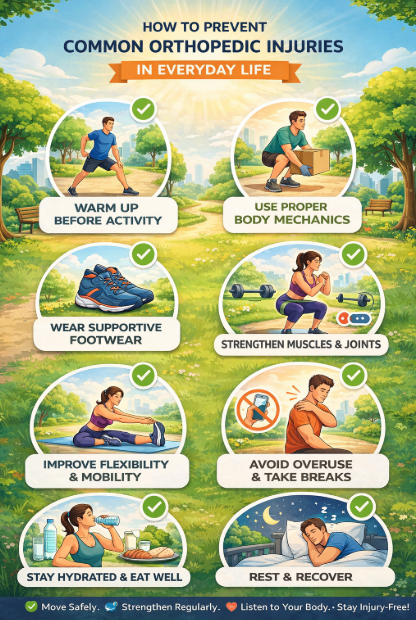
Many people get injured not because exercise is harmful, but because they start too fast, skip warm-up, wear the wrong footwear, or ignore pain. The American Academy of Orthopaedic Surgeons advises warming up before stretching, stretching gently rather than bouncing, and cooling down after activity. AAOS also notes that stretching after exercise reduces injury risk and that stretching cold muscles can itself cause injury.
A good daily rule is simple: progress gradually. If you have not exercised in months, do not try to match your old level on day one. Build walking, stair climbing, cycling, resistance work, or recreational sports gradually. A large share of ankle, knee, calf, shoulder, and back injuries happen when people restart activity after inactivity and ask their body to perform at a level their joints and muscles are not ready for.
Footwear matters too. Shoes should match the activity and provide grip and support. Worn-out soles increase slip and ankle-twist risk. This becomes even more important on uneven streets, wet compounds, stairs, and rough grounds common in daily life.
4) Prevent orthopedic injuries on the road
In Nepal, orthopedic injury prevention must include motorcycles, scooters, pedestrians, and road behavior. WHO reports that road traffic crashes kill about 1.19 million people every year globally, with 20 to 50 million more suffering nonfatal injuries. More than 90% of road traffic deaths occur in low- and middle-income countries, and more than half of road deaths are among vulnerable road users such as pedestrians, cyclists, and motorcyclists.
Nepal’s profile shows how central two-wheelers are to the issue. WHO’s Nepal road safety country profile lists 3.16 million powered 2- and 3-wheelers registered in 2021, compared with about 344,687 four-wheel vehicles. The same profile notes Nepal’s national helmet law applies to drivers and passengers, but helmet fastening is not required by law, and passenger helmet wearing is extremely low in the country profile.
WHO’s Nepal helmet policy brief adds more context: Nepal averaged eight deaths per day from road crashes in 2021, and police records attributed more than 50% of reported crashes to motorcycles. WHO also states that correct helmet use can reduce the risk of death in a crash by more than six times, and reduce brain injury risk by up to 74%. Seat-belts can reduce death risk among vehicle occupants by up to 50%, and drivers using mobile phones are about four times more likely to be involved in a crash. These are not minor percentages; they are major orthopedic prevention tools in everyday commuting.
Everyday prevention table: common orthopedic
injury, common mistake, better habit
| Everyday situation | Common orthopedic injury | Common mistake | Better prevention habit |
| Wet bathroom or kitchen floor | Slip, wrist fracture, hip injury, back strain | Walking fast on wet tiles or in smooth slippers | Dry spills quickly, use grab support if needed, improve lighting, wear nonskid footwear |
| Carrying heavy groceries, cylinders, or boxes | Low back strain, shoulder strain | Lifting far from the body and twisting while lifting | Keep the load close, lift with the legs, pivot with the feet, ask for help with heavy loads |
| Long desk work or phone use | Neck pain, back pain, shoulder tightness | Slouching for hours and looking down continuously | Support posture, keep screens near eye level, take regular movement breaks |
| Weekend sports after inactivity | Ankle sprain, knee strain, calf strain | No warm-up, no conditioning, sudden intense effort | Warm up first, progress gradually, use proper shoes, stop through pain |
| Stairs and uneven surfaces | Falls, ankle twist, fractures | Poor lighting, clutter, rushing, holding items in both hands | Keep stairs clear, improve lighting, use railings, keep one hand free |
| Motorcycle or scooter travel | Fractures, head injury, spine trauma | No standard helmet, unfastened helmet, distraction, speeding | Wear and fasten a quality helmet, avoid phone use, obey speed limits, use safer riding habits |
| Older adult walking at home | Fall, hip fracture, head injury | Ignoring dizziness, weak balance, poor footwear | Review medicines, test vision/hearing, do balance-strength exercises, use the right walking aid |
The prevention habits in this table are consistent with guidance from NIH, NIA, AAOS, WHO, and Nepal-specific injury data.
A practical daily orthopedic injury-prevention routine
The best prevention plan is one people will actually follow. A realistic daily routine can be very simple: start the day with a few minutes of mobility, avoid lifting in a rush, break up long sitting, wear stable footwear, keep floors and stairs safe, and use proper protection while traveling. For older adults, add balance work and home safety checks. For manual workers, add lifting awareness and load-sharing. For riders, make helmet use non-negotiable.
One more important point: pain is not always a signal to “push through.” A mild strain may settle with rest and guided recovery, but persistent swelling, joint instability, reduced range of motion, repeated ankle rolling, worsening back pain, or inability to bear weight deserves medical assessment. Early care can prevent a small injury from becoming a chronic orthopedic problem.
When to see an orthopedic specialist
You should seek medical assessment if pain follows a fall, crash, twist, or lifting incident and does not improve quickly, or if there is swelling, deformity, numbness, weakness, locking, instability, or difficulty walking. Urgent care is especially important after road crashes, major falls, suspected fractures, severe back pain with weakness, or injuries that stop normal movement. WHO’s road injury guidance emphasizes that post-crash care is time-sensitive, and delays can increase injury severity.

For patients in Kathmandu, Nepal National Hospital positions itself with orthopedic care, trauma-focused services, physiotherapy support, and 24/7 emergency response. Its official pages list orthopedic consultants, trauma surgery, spine surgery, physiotherapy-related recovery content, and emergency access through Hotline 1147.
Final thoughts
Preventing common orthopedic injuries in everyday life does not require perfection. It requires awareness, small habit changes, and fast response when something feels wrong. The biggest risks are often ordinary ones: wet floors, poor lifting, weak conditioning, rushed exercise, unsafe footwear, bad posture, and careless riding habits. The numbers show why this matters. Falls and road injuries remain major causes of death, disability, and hospital visits, while back pain and other musculoskeletal conditions continue to limit daily life for millions.
For readers looking for an orthopedic hospital in Nepal or an orthopedic doctor in Kathmandu, the message is straightforward: prevention should start at home, at work, during exercise, and on the road. But when pain, swelling, injury, or reduced movement appears, early expert care matters. Nepal National Hospital offers orthopedic services, trauma support, physiotherapy-linked recovery, and 24/7 emergency access in Kalanki, Kathmandu.
Call to action:
If you have back pain after lifting, repeated ankle sprains, knee pain, a fall-related injury, or a fracture concern, contact Nepal National Hospital orthopedic hospital in Nepal for orthopedic evaluation and timely care.
FAQ
What is the most common orthopedic injury in everyday life?
Low back strain, ankle sprain, knee strain, and fall-related fractures are among the most common everyday orthopedic problems. Globally, low back pain is the biggest contributor to musculoskeletal disability.
How can I prevent back injury while lifting?
Keep the object close, use your leg muscles, tighten your stomach muscles, and pivot with your feet instead of twisting your spine. Ask for help with heavy loads.
What is the best way to prevent falls at home?
Improve lighting, remove clutter, use nonskid footwear, review dizziness-causing medicines, and add balance and strength exercises, especially for older adults.
Why is motorcycle safety important for orthopedic injury prevention in Nepal?
Nepal has a high road injury burden, and motorcycles account for a large share of traffic crashes. Correct helmet use greatly reduces death and brain injury risk.When should I see an orthopedic doctor?
See a specialist if pain is severe, swelling persists, you cannot bear weight, a joint feels unstable, or symptoms follow a fall, crash, or lifting injury.
